
s

SmellyBlog

Diorella


Before I begin, I have two announcements to make: First of all, I want to thank the generous Joanna for sharing a decant of vintage Diorella with me. This review is based on my subsequent wearings of this beautiful rendition, prior to the oakmoss banning days. My second confession is that some ten or so years ago, when Diorella was quite widely available (and before oakmoss was so ridiculously restricted) and it did not quite capture my heart. While I liked its freshness and similarity to the brilliant Eau Sauvage, here was something about it that I disliked - a combination of the heaady floral note of honeysuckle, and the soapy aldehydes at the opening. Time perhaps has been kind with Diorella, because she has aged gracefully. Or perhaps it is an even earlier formulation of the same one. But it is certainly different from the scrubbed and lathered version you’ll find on the Dior counters nowadays.

Way before its time, Roudnitska was at ease incorporating fruit salad elements in his fragrances in a most refreshing, light-weight manner... created in 1972, Roudnitska’s fruit has thankfully no affinity with the syrupy, unbearably sweet fruity-gourmand florals of the new millenia; but rather posessed a cheerful lightness paired with complex substance from more earthy and floral notes of natural raw materials. So again, these are far superior to the light, watery fruity-florals of the 90‘s, though these were strongly influenced by the asthetics that Roudnitska developed with the creation of Eau Sauvage, which introduced the concept of space and expansion to modern perfumery.

Diorella is munching on a honeydew melon (or is it a cantaloupe?). It is ripe, juicy yet somehow still crisp, as it is brilliantly paired with citrusy notes of lemon and bergamot and a touch of spicy-sweet green basil. Her peach-toned skin emanates a scent that is similar to white peach’s delicate, milky and slightly nutty aroma, due to the use of peach aldehyde and peach lactone. These unique fruity notes were both brilliantly used in a non-edible way (as Edmound Roudnitska explains beautifully in Michael Edward’s book, Perfume Legends - French Feminine Fragrances). Rather, it brings freshness and a unique texture to the jus. It is brilliantly paired with effervescent, ethereal and soapy honeysuckle, crushed basil leaves and a tad of the oily aldehydic notes backed with ionones, that simultaneously give the clean impression of triple-milled soap, and the dirty allusion to hosiery that’s been worn and sweated in for at least half a day. That dichotomy between anti-bacterial herbs and animal/human secretion seems to be at the core of Diorella.

The oily aldheyde and peach notes fades rather quickly, allowing the basil and citrus notes more breathing room. Orris butter is present yet very subtle, giving a soft-focus background to the composition, and making it somehow smell more feminine. What truly moves to the forefront is jasmine. Pure, unadulterated, indole-rich jasmine at its best. And it is that indole that will accompany Diorella throughout her strut on the skin and the surrounding air - first an ethereal jasmine, and later on a full, unabridged indolic jasmine, with its fruity, jammy peach-like and earthy and animalic character beautifully showcasing this gorgeous phenomenon. The similarity to Le Parfum de Thérèse as well as Eau Sauvage are striking; but what surprised me what the affinity I discovered with Eau d’Hermes. Also a perfume that is all about jasmine, yet from a very different point of view - more warm, sweet-earthy and spicy. It is probably the juxtaposition of jasmine with ionones that creates that olfactory connection for me.

Last but not least, it’s time to talk about the base notes, the foundation of Diorella. No matter how much Roudnitska denies any connection to Eau Sauvage, the similarity is striking, despite the differences. There is definitely oakmoss, but not nearly as much as in Eau Sauvage, which gives it more of a green, dry and woody character rather than a dense, brown-earthy and musky feel. Vetiver also supports it in this direction. Even the patchouli, which appears in both, seems to be toned down and instead of the big-warm-oily patchouli hug you get in some feminine Chypres such as Miss Dior - there is just a single brush stroke of it, done in aquarelle. Last but not least, where Eau Sauvage has a generous dose of hay, which gives it an almost-fougere quality, Diorella has a subtle sprinkle of tonka bean (or perhaps just pure synthetic coumarin - in reality there is a very small difference between the two), giving it a slightly bitter finish, but with that feminine soft-focus that reflects the orris from earlier on.

Diorella is a very Mediterranean perfume, and truly reminds me of Grasse and the surrounding area, including the perfumer’s home and garden (which I visited in 2009). It also reminds me of a perfume that his son, Michel Roudnitska created way into the future - Eau Emotionelle - also playing on the cantaloupe-jasmine-ionone theme, but in oil-pain strokes rather than the sheer aquarelle of his father's. The culture in that area is greatly influenced by Italy and Spain, and there is something very Italian about it, especially in the opening notes. If Diorella was a woman, she would be one with a very outgoing, young spirit. A woman that loves to laugh and enjoy life’s pleasures, and just goes with the flow - but isn’t audacious or dominant by any means, and is very kind, generous and open but without ever being vulgar in the least. There is something truly carefree, open, fun, bursting with life and joie de vivre about it. In case you didn’t know already - it’s a true masterpiece. It has been relatively recently re-introduced along with the other classic retro Dior-fumes: Diorling, Dioressence, Diorama... I’m sure the new version pales in comparison but I’m nevertheless intrigued to find out what they’ve done to it to overcome the restrictions on jasmine levels and the industry’s new (low) standard of avoiding oakmoss at all costs (even though it is still allowed - the washed-down version of atranol-free absolute, and at only very low percentage).

Top notes: Bergamot, Lemon, Basil, Melon, Aldehydes, Peach
Heart notes: Jasmine, Honeysuckle, Hedione, Orris, Violet
Base notes: Oakmoss, Patchouli, Vetiver, Coumarin
Must Read: A Toast Story

Aside from the odd and gimmicky fragrance reference of Eau de Toast, today's must-read article has nothing at all to do with perfume. I strongly urge you to read this inspiring story in the Pacific Standard, written so well by John Gravois. On the surface it seems to be about tracking down the source of a trend (artisanal toasts - have they arrived to your neighbourhood yet?!). But truthfully, it is a story about one woman's unique way to struggle with a major challenge life has thrown at her, and a big reminder on how important it is to stay connected to other breathing, living human beings. And of course, it resonated with me not only because I'm also a woman entrepreneur; but also find there is an immense healing power in swimming in the uber-cold Pacific ocean.
Read it!

Musk Malabi

Malabi by Tom lahat
Malabi, a photo by Tom lahat on Flickr.
If Sahleb is the royal treat of winter, then the rosy, rubbery Malabi (see recipe below) is the queen of summer in the Middle East. Served cold in every other corner and almost every kiosk and restaurant of any caliber, this chilled milk-pudding captures the eye with the contrasting rosy-red syrup oozing all over the white, petri-plate-like to-go containers it comes in. I was never a big fan of its texture (ditto in regards to Rahat Loukum, also unjustly made with corn starch instead of better quality materials), but I adore its fragrance!

What always captures my imagination about malabi was its soft, evocatively sounding name, and its unique fragrant combination of rosewater and neroli. Rose and neroli are such noble flowers yet oh so different. Rose is open, voluptuous, sweet and feminine. Neroli is prim and proper, restrained, clean, ethereal and otherworldly. It's incredible that such a thing even grows from the earth, as has such a heavenly character.

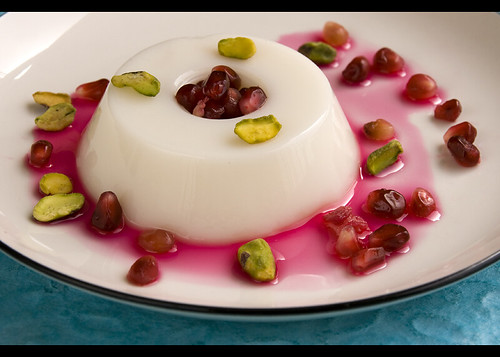
Malabi with pom syrup by Dan Bar Dov
Malabi with pom syrup, a photo by Dan Bar Dov on Flickr.
The balance of these two strong-willed floral elements that inspired the creation of my new, limited edition for Valentine's Day 2014. Titled Musk Malabi, this perfume is a holy triad of sorts, between voluptuous, velvety and soft rose; airy, clean and cerebral neroli, and the pulsating animalic energy of musk. The musk is, in a most profound way, what makes these two oppositional flowers harmonize rather than compete with one another. It is told in the Koran that Mohammed's breath was as sweet as rose, and that he considered musk to be the purest of all perfumes. Musk grains were even mixed with the mortar in the construction of several Eastern mosques and retained their musky scent for years. The botanical musk in Musk Malabi was designed to smell as close as possible to deer musk, and most importantly, act like one: it plays cupid pulling all the strings between and drawing the lovers (rose and neroli) together. It doesn't need arrows, and plays the harp better than cupid, doing all of this work gently and with effortless fluidity. 

Malabi by shai.wininger
Malabi, a photo by shai.wininger on Flickr.

Musk Malabi is a limited edition for Valentine's Day 2014, which is just a month away from today! 
Love it, and it will love you back.

Top notes: Bitter Orange, Cardamom, Coriander, Blood Orange
Heart notes: Turkish Rose, Bulgarian Rose, Tunisian Neroli, Egyptian Orange Blossom
Base notes: Atlas Cedarwood, Botanical Musk Accord, Tahitian Vanilla

Malabi (Recipe)


Malabi by Ayala Moriel
Malabi, a photo by Ayala Moriel on Flickr.
Malabi is a Middle Eastern dessert, a milk pudding thickened by rice flour, which is usually served cold like Panna Cotta. Unfortunately, most of the malabi recipes, as well as what you'll find on street corners and even in restaurants are made with the inferior cornstarch, giving it (what I think is) an unpleasant aftertaste and a rubbery texture.

The dessert is made simply by cooking milk and starch as if to make a pudding. It is only minimally sweetened, if at all, and always must be flavoured with rosewater and orange flower water, which is the only thing that really sets it apart from the old fashioned baby-food that was served in the 1950's (when mothers were convinced that fattening a baby with modified starches is the way to prove that their kid is not malnourished). You may serve it warm; but the traditional recipe is for chilled malabi, which gives you room for many creative serving suggestions (i.e.: using moulds, fancy cups, garnishes, syrups and toppings).

This recipe is adapted from May S. Bsisu's excellent book "The Arab Table" (p. 322) and from Israeli Kitchen. Please note that malabi has many other names and spellings (i.e.: Mohalabia, Malabia, Muhallibieh, etc.). She also offers several regional variations on this dessert (for instance: whole green cardamoms and saffron strands are cooked with the pudding in Saudia Arabia), including the explanation about the Syrian and Lebanese version using rice flour instead of corn starch, which is my personal preference. Note: if you want a more gooey, jelly like consistency, use Sweet Rice flour, aka glutinous rice, which is easily obtained in Asian grocery stores. For a more wholesome variation (which is great especially if served warm) use brown rice flour. Note regarding the mastic: this resin adds to both the flavour and the texture of the dessert, making it more gooey, but also making the flavour a bit different (and it is an acquired taste). 

8 Tablespoons Rice Flour, whisk and dissolve in 1/3 cup of water.
4 tsp sugar
1 L whole milk
1 Tbs rosewater
1 Tbs orange flower water
Pinch of mastic resin (optional).

For the garnish:
Date honey (also called molasses), Pomegranate molasses, grenadine, rose syrup or rose petal jam.
Toasted, crushed, unshelled and blanched pistachios or almonds; OR fresh pomegranate seeds; OR ground cinnamon and cardamom plus crushed nuts. 

 - In a small saucepan, begin heating the milk and sugar.
- Gradually add the rice flour and water and rice mixture, and cook over medium heat and simmer, stirring continuously in order to prevent lumps from forming.
- Add the mastic, if desired. 
- Once the mixture had thickened into a custard-like consistency (in about 5 minutes), add the rosewater and orange flower water. 
- Pour into small ramekins or dessert bowls, a bring to room temperature. Cover with a plastic warp and refrigerate for 2 hours. Serve with a garnish of nuts and your favourite syrup.
- Please note: These do not invert well (like panna cotta), but will have to be eaten out of the ramekins, similarly to a custard or a Crème brûlée. 

Cabochard de Grès

Cabochard was reated in 1959 by perfumer Bernard Chant for French couturier Germaine Émilie Krebs (publicly known as Alix Grès or Madame Grès). Cabochard in many ways preceded its time and the trend that will dominate the 1970's - green, formal florals, often soapy, and at times even icy. However, while Cabochard is definitely green, it has the joie de vivre of the genre's founder, Vent Vert, and a warm yet playful personality which I can only guess has a lot to do with Madame Grès' vision and personality.

While most of the successful couturiers fashion houses of Paris followed their success to become more commercial, the house Grès remained purely dedicated to haute-couture. Everything was done by hand, made to measure, and with utmost attention to detail. This can usually only last as long as the founder is alive and working. And so, sadly, when Madame Grès retired in the 1980's, the business was sold, but while the couture was pretty much lost, the fragrance part remained alive and kicking, even if they don't launch a new fragrance every other day...

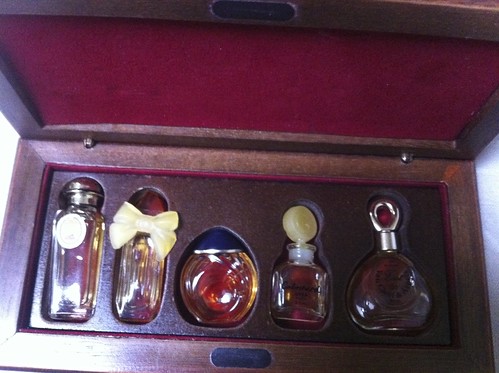
I came across Cabochard before, but wasn't really "grabbed" by it until a generous perfumista gave me this vintage coffret of minis of various concentrations, which is probably from as far back as the 80's. Enough time to disintegrate the rubbery lid (I had to use an actual corkscrew to pluck it out!) but it has retained its scent beautifully.

I was first intrigued by the scent; then by the story of Madame Grès - whatever of it I was able to pick from the very little information is found about her - mostly in French. She's not nearly as known as Gabrielle Chanel, and even more enigmatic. She was married to the Russian sculptor Serge Czerefkov, which I'm certain had some influence on her art: her pieces have the a solid structure wrapping around the female form, yet draping in innovative ways, showing the fabric's flow, texture and bringing out intriguing shapes and silhouettes by the interaction between body and garment. As to her personal style - she seems to be sporting a turban at almost all the photographs of her, which makes me wonder if she had hair at all, or was just obsessed with the Orient.

Cabochard means stubborn or hard-ass in French, and the personality of this fragrance makes me think that there is something to it. I was, however, surprised to find out via Fragrantica (and upon further investigation in Michael Edward's Perfume Legends), that her fascination with India is what inspired both Cabochard and another twin fragrance called Chouda, supposedly a floral, which never quite came to be. The latter was designed by Guy Robert, and was an ethereal floral, to resemble a flower she encountered in India, possibly water hyacinth (which I find unlikely, as it is native to the Amazon basin). By the sound of the name, I think it might have been kewda, which has hyacinth-like quality. Although this was reportedly Madame Grès' personal favourite between the two, she decided to go with the bold green chypre, which was more trendy at the time.

Despite some marketing material alluding to Cabochard being inspired by a walk on the beach of Southern India (again, rather unlikely that a tropical beach would smell that green and bitter), there is nothing quite India-related in Cabochard as far as I can smell. But it sure smells like a strong-headed gal with a great sense of humour, which is how I imagine Madame Grès to be in real life. Some further reading also revealed that unlike Chanel, she strongly opposed the Nazi occupation of Paris, and insisted on displayed the tricolor flag on her shop (which ultimately resulted in the Nazis closing her shop). I admire her now not only for her talent, but also for her courage.

Cabochard is so many things - green, leathery, woody, floral, indolic... It begins with a definitive juicy-green character, like frsehly squeezed wheatgrass; yet there is something ashy and dry underneath. The health-concious wheatgrass juicer is also a chain smoker. The nicotine in her veins brings the best of her - creativity, energy, laughter. It's balanced again with some medicinal sage, and pretty, clean and proper neroli and enough rose to make you think of a rose garden but not smell like an English lady. Orange blossom and jasmine make advances as the perfume develops on the skin. These two bold notes, while indolic and dirty, also have a zest of life to them, a very forward personality, with the methyl anthranilate shining through beautifully and bringing some sweetness into the green. They are only ever so slightly soft-focused with powdery orris note. As for the base - it's what you've always dreamed of: oakmoss, tobacco and vetiver, with some isobutyl quinoline for good measure.

Cabochard to me seems to have predicted the future of the 1970's - No. 19, especially, to whom it is a very close relative with the same motifs of leather, greens, juicy citrus notes, iris, leather and vetiver; interplay between green, dry and floral-powdery. As well as everything that followed, dominated by green, herbaceous and soapy notes. The leading scents in this trend were No. 19, Ivoire, Estée Lauder's Azurée (by perfumer Bernard Chant), Alliage and Private Collection; Coriandre, Calandre, Chamade, 1000, AnaisAnais, and Aromatics Elixir (also designed by Bernard Chant), and of course Rive Gauche. I'm glad I found out who is the perfumer behind it (though I'm certain that Guy Robert's Chouda was magnificent!) and see the connections with his other creations.

Top notes: Sage, Rose, Neroli
Heart notes: Jasmine, Orange Blossom, Orris

Base notes: Vetiver, Leather, Oakmoss, Tobacco
Back to the top