The following will be the first in a short series of conversations with Canadian perfumers (there are far and few of us). I met Jessica September Buchanan in
Grasse in May 2009. It was one of those rare "Facebook moments": I came back from the
rose fields, and found several friendship requests from Spanish people I've never met before, and had a message at the front desk from a Jessica, whom I just learned that week was a student who just completed her full year course at the institute where I was attending a week-long course - and happened to be from British Columbia. A rare coincidence.
A day or two later of attempts to bypass the limitations of roaming charges and weak wi-fi connections, we finally were able to make a Skype conversation and arranged to connect in person, a night before my course was over. I walked up to her apartment - the top floor in an old building (well, pretty much everything in Grasse is rather old), met her friend who just took the train in that day from Italy, had a glass of vino, sniffed some vintage molecules that are no longer allowed to be used in production - dabbed some perfume, and left for the party.
It was a barbecue garden party that took place at a perfumer friend of Jessica, who worked at the naturals department of a supplier house. His house was part of a newly renovated compound that used to be an old perfumery with chimney and all. The moment I met him, I realized he was actually a Facebook friend: non other than Pierre Bénard of
Osmoart. As well as nearly all 20 or so guests at the parties, who were mostly students from the flavour & fragrance program in the university of Barcelona... Now all the Facebook action made sense!
Jessica and I remained friends ever since, and we try to
meet whenever we happen to be in the same city, which does not happen often enough. I will always remember that night, walking through the narrow and winding stone-paved streets of Grasse - Jessica enveloped in a fine mist of
Après l'Ondéeand me with my fresh-from-the-studio
Hanami, which I just launched in
Los Angeles the previous month. Jessica's love of violet is not limited to classic Guerlains -but is also evident in most of the work I've experienced: ionones are an accent in her
Reglisse Noir, and wild violets inspired
Fleur No 1. It is a pleasure and an honour to have Jessica September Buchanan as a guest on SmellyBlog for a rare perfumer-to-perfumer conversation that touches on influences, identity, raw materials, and the long process of birthing an indie brand in a world full of the opposite.
Ayala Moriel (SmellyBlog): How did a Canadian nature girl like you end up in the French Côte d'Azur?Jessica September Buchanan (1000Flowers): Initially I came here with the intention to stay for only one year, while I attended the Grasse Institute of Perfumery. But then I became quite smitten with the climate and the magic of the place. Then I also had the dilemma of loving both here and Canada, and feeling somewhat torn as to where I wanted to be. (the true sensation of having a foot in two different worlds). I decided on Grasse, since I thought it would be beneficial for the identity of my business.
Ayala: Torn between two worlds is a feeling I can relate to, being born here but raised in Israel - two completely different environments, from both climate and people's temperament and culture. Do you feel that your perfumery style or themes were affected by the change of scenery? Jessica: Yes, so you understand completely. And you chose Canada, rather than your birth country... and I ended up choosing France, rather than my birth country. There is so much more to learn from a culture other than our own.
Ayala: I was actually not born in Israel, but in Montreal... Being raised there made moving back to Canada feel the same as immigrating, except for the paperwork. I still relate this entire experience as a journey...Over 14 years long, but who is counting? ;-)
When did you start 1000Flowers? How did you pick the name?
Jessica: Initially I started my company in 1998, and it was called Matricaria Plant Essences. I began with a collection of pure essential oils and several skin care products that I created. (Rain Gel, Mexican Cleansing Grains, and a body oil.)
In 2002, I had a conversation with a Vedic astrologer, and a Sanskrit word kept coming up that translated as 1000 flowers, or 1000 plants, or 1000 medicines. I was quite smitten with this, and after about a week of reflection, I decided to change my company name. Soon thereafter, I also incorporated under the same name.
Ayala: That's beautiful and serendipitous - especially with your background of using plants for healing (aromatherapy). And I can't help but asking - are you aspiring to make 1000 perfumes for the line? Or incorporate 1000 of them into your formula? Jessica: That is something I've joked about with friends... But I think that may be a bit too ambitious! I think it will remain mostly symbolic in the name... But who knows... We'll have to see how many perfumes I have created by the end of my life!
Ayala: What inspires you? Jessica: Nature. Love. The sea, the forest, plants, flowers. Also, certain artists - Picasso, Georgia O’Keefe, Charles Rennie Mackintosh, and Margaret Mackintosh, for example. I love the aesthetics of design, and find inspiration all around me in that regard. I am also inspired by certain perfumes... It is pleasing to smell creations that are balanced and well-constructed with fine materials.
Ayala: Is it true that you designed your own logo and packaging? How do you manage to do all this alone? And do you think there is an advantage to full creative control, or do you sometimes feel the need to "step back" and let someone else handle an aspect of running 1000Flowers (i.e.: marketing, packaging or even just the bookkeeping)?Jessica: I originally had a graphic designer do a branding project for me. We worked closely together and she designed the logo and the round seal that is on my website. Since then, I learned the Adobe Creative Suite, and simply work within the structures that are already there. Any photography (on my site etc.) are my own. I enjoy immensely graphic design and photography.
Ayala: What is your vision for 1000Flowers as a brand and a business?
Jessica: My vision is to develop the brand, and eventually to open a boutique that embodies the identity visually as well as ethically of what 1000 Flowers stands for. This includes simple and elegant beauty (black, white and grey), and fragrances (based on precious natural materials), that translate my personal expression of the art of perfumery.
In the meantime, I just launched two new fragrances, and have several more in development. I am working to expand the collection to offer more choices from the brand for perfume enthusiasts.
I am also beginning to offer the service of fragrance design for other companies.
Ayala: Tell me more about your upcoming scents! I know that Fleur No. 1 is inspired by the spring and snow melting on the mountains of interior British Columbia. Do you find yourself inspired by your current Mediterranean surrounding? Jessica: The two new scents are called
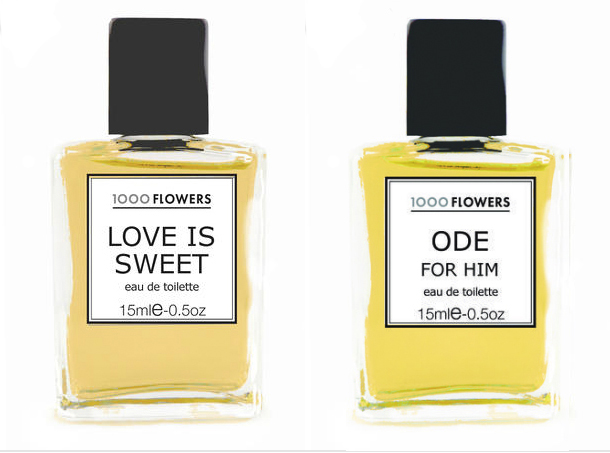
Love is Sweet, and
Ode for Him. They are actually inspired by a love story. They are an ode to love... it's a personal story as well as an exploration of love and relationships in general. I wanted to offer an idea that was uplifting and positive. The world these days needs more of this.
Ayala: Love is always a relevant topic. And especially at this day and age - I feel many of us need a reminder of the sweet part of it. So many of us are left only with the bitter aftertaste when it ends, or forget to appreciate it if it turns into a long-lasting domestic relationship. Thanks for taking that role!
Jessica: I also got a hold of some real oud, so as much as it is a material that has already been explored in many fragrances, I was inspired by such a magical material. I decided to create an 'Aromatic oud', so a bit different than the usual themes. I suppose this was the touch of Mediterranean influence in the sense that herbs are such a part of this region.
Also, I have an amazing vanillin isolate, and fell in love with a molecular distillation of patchouli. So with these materials that I was in love with, I set out to create two fragrances around them- a pair. Therefore Love is Sweet is built on vanilla and patchouli, with notes of violets (natural ionones), and rose. It is quite rich and is meant to be reminiscent of more vintage and romantic fragrances.
Ayala: You keep coming back to these violets!
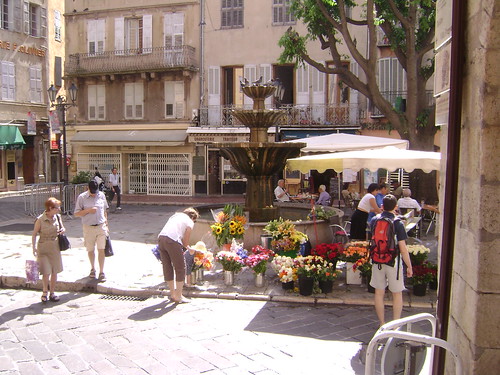
Regarding oud, it’s overdone marketing wise, but the possibilities are not even close to being exploited from the creative perfumery point of view. I’ve been working on an oud fragrance for years now, that is in conjunction with less-well-traveled notes, and although I’m very far from being satisfied with the outcome so far - it’s a worthy journey to travel. I think it’s very befitting that you chose Mediteranean herbs to go with the oud. It is so popular in Arabia, and the herbs are certainly what characterizes the natural aroma of the region's hillsides - aka garrigue. Jessica: In regard specifically to the Mediterranean, there are so many things that inspire here. There are flowers blooming from February onward. The hills covered in mimosa trees in full bloom, the banks of stone walls covered in purple wisteria (or later in summer, jasmine), the citrus trees in blossom, the wild lavender and thyme....etc etc. It is quite amazing.
Ayala: I adore wisteria! I just smelled white wisteria recently in my visit to Berkeley. Yuko Fukami brought some to the Perfumer's Afternoon Tea and it's stunning! And I will never forget the wisterias in Versailles's gardens.
Orange blossoms are a great inspiration for me and evoke spring more than anything else (see Zohar). And I'll never forget picking mimosas from the side of the highway to Tel Aviv visiting my grandma. It was her favourite flower. Now on to a question I'm frequently asked by my customers: What's in a name?
And more specifically - are your upcoming perfumes going to be named Fleur No. 2, 3, etc. till 1000? Or will they be more evocative of a personal story like Reglisse Noire is?Jessica: I think each perfume wile quite different. I had thought about doing a series to follow Fleur No 1, yes. And that idea is still active. I think each fragrance will be quite different and each will have a personal story.
Ayala: What are the challenges you are facing being an independent perfumer in the French industry?
Jessica: The main challenge is that the French population is not really interested in small, relatively unknown brands. They are accustomed to, and highly value their own known luxury brands, and don’t really step outside the box so much. They are quite traditional and do not have the sense of adventure that we have in North America, or even in other European countries for that matter.
Ayala: It's true - and especially on the West Coast, the independence and freedom is apparent in the flourishing and thriving movement of independent perfumers-creators. Some even openly call themselves "underground" or "outlaws" in the sense that they are putting the art first and IFRA standards at the bottom of their priority list. Pretty much the opposite of what's happening in Europe. How are you planning to overcome that? Jessica: I am not limited geographically thankfully. Since I sell online, there is no limit. However, my niche here in France, is that I am a trained perfumer, and I speak English. So other opportunities are opening up.
 Ayala: There is something to be said about the internet. It gives a lot of flexibility and freedom, and opens up the path to very specialized niche audiences in faraway lands.
At the same time - it’s great to hear that Grasse is opening new opportunities for you locally! What are the other advantages in being in Grasse?
Jessica: The advantages are of course, direct access to the best raw materials, both natural and man-made. As well, of course, the reputation and mystique of Grasse is important for my brand. But I think, in relation to actual sales, my market is not here. That said, there is endless inspiration here in the form of a real perfume tradition with many perfumers and people who work in various facets of the industry, so that offers a real richness professionally.
Ayala: I want to hear more about new raw materials you found in Grasse! Anything exotic or unexpected? I recently smelled fresh Szechuan pepper essence and eucalyptus absolute and am completely in love!
Jessica: Actually I haven't found anything really new here... other than perhaps Lentisque absolute- which is a shrub that grows here up in the mountains. But other than that, the best part is that there are many producers here of the best lavenders, clary sage, etc. So that in itself is wonderful.
That pepper essence sounds amazing!
Ayala: It is amazing!
Note to our readers: Lentisque is the French name for mastic (Pistacia lentiscus), from which the gum “Mastic” is derived (used in desserts such as sahleb and ice creams as well as chewing the resin as it to freshen one’s breath). There is also an essential oil and absolute - which is a less-known as a perfumery note but definitely worth the attention: green crushed leaf fresh top notes with resinous-balsamic undertones.
Do you feel that your perfumes have an identity - i.e.: Are they more "Canadian" or "French"? Are they more "natural" , "modern" or "old fashioned"? (just a few rather generic examples to be able to explain your brand a bit more).
Jessica: My fragrances are a fusion of French (due to my education and approach to creation), and Canadian, (in the way I use and gravitate to high proportions of natural raw materials and am deeply inspired by an awareness of health ‘west-coast style’). They tend to be more in the vintage direction (again due to the naturals and due to my personal taste), but modern in the sense that I keep them quite uncomplicated. As my collection of fragrances grows, I think that one will find that my style can be eclectic. Especially with the two fragrances that I am just about to launch. One is a men’s fragrance, and it is leaning a little more in the modern direction due to some of the materials I have used to accent this effect. As an independent, it is important to not completely exclude the commercial market if one is to survive.
In a general sense, my style is quite gentle and personal. I like the idea of fragrance staying close to the body and being an intimate experience where the wearer invites others in to experience their scent rather than intruding on others with aggressive scents.
Ayala: How did your background in aromatherapy influence your choice of materials? Jessica: My background in aromatherapy gave me an in-depth understanding of the naturals in relation to chemical structure, as well as to therapeutic effect and safety concerns. I do adhere to IFRA (International Fragrance Association) guidelines, but even more, I keep in mind Aromatherapy safety guidelines, which are in fact, more stringent.
As well, since I know the naturals so well, that I find them easier to work with. More and more, I am experimenting with merging the different palettes, and learning the traditional art of modern perfumery integrating modern materials. It is fascinating to write scent compositions with an ever-growing collection to draw from. It is a life-long process of learning- and deeply challenging. (as much as it is rewarding).
Ayala: Tell me more about your learning experience in GIP. I also recently saw that you're teaching there - how exciting! Jessica: The year at GIP was amazing in so many ways. Technically, the first 3 months were spent studying the raw materials. Then we began to look at actual creation, history, fragrance genealogy, etc. It was very challenging and I learned a great deal about creation, as well as the industry. As well, I did 2 internships in large traditional companies (Robertet and Mane), which were incredibly interesting.
Ayala: How exciting it must have been to do internships with these two influential supply houses. You must have learned a lot!
Jessica: As for teaching, I was invited to teach the advanced Natural Perfumery course in summer 2012, as well as a segment of the Level One courses for 2013. I wrote the curriculum for the advanced level. I based the course on the Jean Carles method of teaching/learning. For a 5 day course, it was intensive.
I have also begun to teach a
course in ASFO (the training center under the National Association of Fragrance Manufacturers (PRODAROM), that is designed for French who work in the perfume industry who want to learn the perfume vocabulary in English. The first group to sign up for the course, include people who work in the flavour industry who want to learn more about fragrance, as well as a perfumer who simply wants to improve his english. Mid-may I will be travelling one day per week to upper Provence to teach the same course in-house to the employees of a company who produces lavender, clary sage, and other essential oils. I am very excited about this, as I will be able to see some countryside, (it is 3 hours by car from Grasse), and to make some contacts with a company like this directly.
Creating this course is really addressing an important need in this day and age where English is so important. The French are not strong in this language, and since I am trained in France in perfumery, and I speak English as my mother's tongue, I am able teach such a specialized niche course.
Ayala: Thanks so much, Jessica - and wishing you much success with the new teaching projects and the new perfumes!For those of you who will leave a comment on this post - your name will be entered into a draw for samples of 1000Flowers'
Reglisse Noir,
Fleur No. 1 and
Narcotic Flowers. If you like the descriptions of
Ode For Him and
Love Is Sweet - you'll just have to splurge on a full bottle (they are both now on special).