s

SmellyBlog

Saveur de l'Abricot

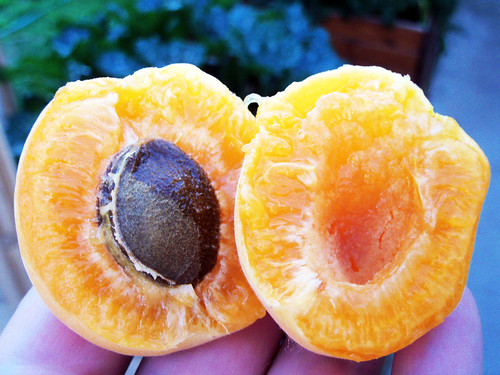
Osmanthus meets goats and apricot schnapps in Artemisia's Saveur de l’Abricot. It opens with a burst of citrus and freshly-split apricot, stimulating the palate with its smooth ripe flavour. And flavour, though most don’t know it - is defined as the combination of taste, aroma (scent) and texture. Saveur de l’Abricot is mostly about the texture, and both the apricot image and ad copy on the Artemisia website are very accurate:
“Picture plucking a ripe apricot from the tree and taking a bite. Feel the velvety, golden skin on your lips. Taste the juicy tang of the flesh on your tongue. Multiple layers of ambrosial sweetness explode with earthy voluptuousness and piquant twist."

What I find most intriguing about Saveur de l’Abricot is the surprising element - the musky animalic undertones, reminiscent of herding goats and sheepskins that lurk underneath. Black current buds fruity yet animalic note also contribute to that effect (some compare it to cat-pee... I'm not one of them but I do agree it is a rather funky note when it stands alone). Seville lavender is another component - which brings to mind garrigue and the goats herding among them. Lavender absolue has more coumarin content, and also a certain velvety texture that is reminiscent of apricots, though the scent is more often compared to ripe raspberries. This adds to the overall textural theme, and brings not only sensuousness, but also a smile -
It's an aprigoat!

Top notes: Blood orange, Apricot notes
Heart notes: Osmanthus, Seville Lavender Absolute
Base notes:
Black Currant Buds, Goat & Musk notes
Osmanthus Conversation with Perfumer Lisa Fong

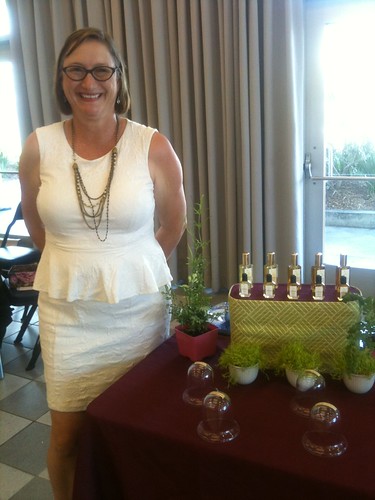
Lisa Fong - Artemisia Perfume

For the third (and perhaps not quite the last...) conversation about osmanthus I invited Lisa Fong of Artemisia Natural Perfume to discuss osmanthus from her unique experience of synesthesia of sounds, textures and colours and her creative process - starting from inspiration through raw material selections, to choosing the name.
Please note: this conversation took place before the 2nd Artisan Fragrance Salon in San Francisco.
 
Ayala Moriel/SmellyBlog: How would you describe the scent of osmanthus?

Lisa Fong/Artemisia Perfume: Osmanthus smells like cherry, sugar, honey, and roots.

AM: How fascinating to receive a completely different reaction from each perfumer in relation to the same scent. I've never heard anyone compare osmanthus to cherry or roots. Thank you for sharing!
Have you ever smelled the fresh flowers?


Lisa: No

Ayala: You should try to get in touch with Ineke (note to self: I should invite her to the Osmanthus Conversations!) and see if you can coordinate a visit to her lovely perfumed garden when the osmanthus is in bloom. That was the only time I smelled it in real life - there were only a couple of little clusters, but they smelled amazing! Quite different from the absolute - which I think is more smiler to the dry flowers.

Do you have any scent memories associated with osmanthus? Or memories that are triggered by this note?


Lisa: Cherry cough syrup from my childhood. I think it was called Chericol, and I loved it.

Ayala: What were the main challenges for you when incorporating this note into your perfumes?

Lisa: Osmanthus is a weak oil and gets drowned out easily. I had this problem so I used a lot of osmanthus and used some black current absolute in the base to bring out the fruity notes.

Ayala: That was my challenge with osmanthus as well - it feels as if the more you add, the less of it remains perceptible. I experience black currants as a top note though, with the characteristic sharp fruity edges wearing off very quickly.


Lisa: I thought black current bud was a basenote. I could be wrong, but I like it in this blend. It seems to help push the osmanthus.

Ayala: I think they are classified as such by Poucher - but find that even with volatility rates, the perfumer's perceptions vary - so I totally value your experience and perspective of it.  Have you noticed anything unusual about the behaviour of osmanthus in a blend?

Lisa: It is very complicated and it will tend to disappear.

Ayala: Your osmanthus perfume is themed around apricot, a fruit that often is used to describe the aroma of apricot. How much of the apricotiness is real, and how much is suggested by the name alone?

Lisa: For Saveur de l'Abricot, I used real, natural apricot essence. It was perfect with the osmanthus, which has a fruity quality, but also a sort of animalistic sense. I really like the fuzziness of the apricot and tried to bring that out by adding mango leaf essential oil.

Ayala: Was this an apricot extract, or an apricot specialty? (note to readers: specialty is a compounded accord that is designed to smell like notes that would be difficult to extract in other methods).

Lisa: I thought this was actually from the apricot,but after talking with Miriam of Robertet, I now think it is a blend of natural essences made to imitate apricot.

Ayala: While we're on the topic - what's in a name? What part does the naming play in your creative process?

Lisa: The name is the last and the hardest part for me. I never start with a concept, when I try it goes horribly wrong. I must stick to the scent itself and how I wish to develop it by adding other elements. When I finish, I try to write a description of the scent, and from that find a name that reflects what I think the scent is about. With Ondine, I felt the fragrance was watery and named it after the water nymph. Since then many people do not smell the water idea, but they like it anyway.

Ayala: To me Ondine is like warm water - like hot springs.
What an intricate process - it's almost as if you're going back and reflecting/assessing your creation in order to name it.
In your mind, what is the role of the name, then?


Lisa: I see the name as a way of summarizing the fragrance and what it is I tried to capture in formulating it. I find it is so hard to describe scent in words, it seems like an impossible task. The name is really important and I never know if I choose the right one.

Ayala: How does your background as a musician affect your style of composition?

Lisa: It has everything to do with my subconscious perception of the construction of the scent. Music is both intellectual and emotional. Since I have been a musician for most of my life, it is just a part of who I am. Order and logic are important, but I also like a bit of chaos and will toss in some strange ingredients to make the fragrance more interesting.

Ayala: Do you feel or refer to scents in terms of vibrational frequencies, such as sounds or colours?

Lisa: I always listen to music when I blend, and the music does influence the blend. I listened to Chopin when I made Eros. Now I'm listening to the Smiths, it will be interesting to see what I end up with. I've got some synesthesia and I associate scent with color and texture. For example, mango leaf smells green and fuzzy to me and frankincense seems sparkly with all the colors.

Ayala: What inspired you to create Saveur de l'Abricot? What's the story behind it?

Lisa: Well Ayala, remember when you and I visited Eden Botanicals in Petaluma, last July? They had the most gorgeous osmanthus I had ever smelled. We both bought some even though it was so expensive. I decided to make a perfume from it and when blended with the apricot essence, the idea was formulated.

Ayala: Of course I do! That's what got this whole osmanthus obsession started :-)
And since then I met a couple other perfumers and their osmanthus scents, which lead to a more elaborate series of conversations.
So - have you noticed a great deal of different between osmanthus essences from different sources? Do you have a favourite - and why?  


Lisa: Absolutely. I never cared for osmanthus because I had never smelled one I liked. The ones I had smelled like solvent, but the Eden Botanical osmanthus was a revelation.

Ayala: We're fortunate to have a quality osmanthus, and I hope it will be around for a while. It's so wonderful it feels like you just can't get enough… Almost addictive! And since then I've done a few osmanthus experimentations that worked much better than in the days when I was struggling to create Kinmokusei. Since I have the new absolute, I added carrot seed, tea rose and pomelo tincture, which greatly improved the fruity, effervescent quality of the flower.

Lisa: Your osmanthus blends sound fascinating, you always have such creative ideas. I would love to smell what you create.
Thanks for letting me discuss my fragrance. See you in a few weeks!

Ayala: More like a few days now! Looking forward to it. Thank you so much for sharing your insights on osmanthus and the creative process behind Saveur de l'Abricot!

Nerve's Root

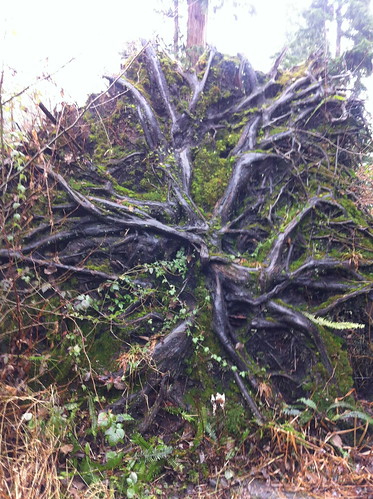
Uprooted by Ayala Moriel
Uprooted, a photo by Ayala Moriel on Flickr.
"A longing to wander tears my heart when I hear trees rustling in the wind at evening. If one listens to them silently for a long time, this longing reveals its kernel, its meaning. It is not so much a matter of escaping from one’s suffering, though it may seem to be so" (Herman Hesse, Bäume: Betrachtungen und Gedichte [Trees: Reflections and Poems] ).

On living vertically: the tree stands still. It only knows upward motion to the light; or drilling to the depths of the dark soil with its roots. Even when the roots need to bypass a resistant rock or crack through a boulder, they are still vertically-oriented. Even when the branches are twining around an obstacle (another life-form, a building or a cliff) they are still climbing towards the sun.

The tree suffers silently. The tree does not even dream of escape or refuge from discomfort or disaster. Fires, logging and frost will attack it to its death, which it will welcome with barely as much as a sigh. It only knows of wandering and travel from the little birds that perch on its branches and whisper their sweet songs of freedom into its foliage.

When its arms are severed and when it is uprooted, a tree does not complain. It continues growing, silently, creaking only when the wind attempts to bend it beyond its range of flexibility. I long for the trees. When the snow and ice piles heavy on its boughs, the tree will carry these heavy waters as a water-bearer with a big family waiting in the village.

Despite all of these limits, the tree knows love. To the birds nesting on its boughs, feeding their youngsters. To the beetles that eat through its bark and tickle its thick skin. To the wind that caresses its tender foliage in springtime. To the children that climb its branches, jump on them and scrape their knees on them. To the earth that hugs its roots, and to the underground parasites pinching at its nerve endings. And even to the savage winds that uproot it; the loggers who take away its pride. It will still continue to grow and move forward, sending shoots of new life around the mother-trunk. 
 I am grateful and perhaps also cruel. In my apothecary I hold many lifetimes of trees and forests combined: essences from the fruits of junipers; needles of fir, spruce, cypress and pine; flowers of linden and balsam poplar; heartwood of santal, cedar, agar and oak; and tears (or sap) from frankincense, myrrh and hundreds of years old olive trees.

From my horizontal point of view, I might envy the tree now. I long for its dangerous exposure to the four elements. Admire its brave silence in face of all adversity. a sudden spring wind had sent me her blessing and promise of hope with a sprinkle of ume (Japanese sour plum) petals on my exercise mat that's been permanently placed by the windows now. The Hanami season is fading, and the scent of balsam poplar buds fills the air with its cotton-like warmth, reminiscent of honey, apricots, yeast and cloves.

FRAGments

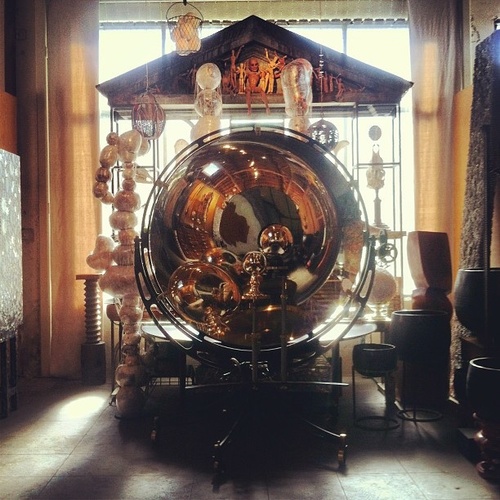
 New blessed initiative is approaching this summer, with FRAGments: Underground, Artisan, and Indie Perfume Collective. It will launch with a pop-up shop and fragrance salon on June 22, 2013 in the Highland Park (Los Angeles) at the cabinet-of-curiosities studio of eclectic sculptor and patron to the arts, Clare Graham. The idea was conceived by my fellow natural artisan perfumer Maggie Mahboubian of Parfums Lalun, and will include a total of 15 perfumers and fragrance artists (complete list TBA). 

The initiative is meant to represent the growing and vibrant movement of artisanal, underground and independent perfumery that's happening in North America - and in particular on the West Coast. The name is an amalgamation of "Fragrance Movement".

Maggie's background as an architect, talent as a perfumer, attention to design elements - and most importantly warm and generous personality that leads this collective - makes this a very promising for this event, and those that will follow. The concept is all around exciting, as the FRAGments website explains:
"
FRAGments will run as a series on the Saturday closest to a solstice or equinox. Each event will take place in a spatially evocative or architecturally significant venue that highlights the urban context of the host city".

Before the sale portion of the event, there will be a panel of perfumers, which will provide content and and insight into this lost art-form, followed by sale. The perfumers will be beautifully curated in the unique space chosen, where each perfumer will be equally represented by 5 perfumes from their line. Perfume shopping requires a more intimate and relaxed environment for testing and sampling, and guests could either purchase full sizes or discovery sets of all 5 scents from each perfumer. 

Please mark your calendar for the following and note the event schedule:

WHEN:
Saturday, June 22nd, 11am-5pm


WHERE:
Moryork Studio
4959 York Blvd
Los Angeles, CA
 

WHAT:
11am-Noon: Moderated Discussion With Perfumers
Noon-5pm: Reception and Collective Pop Up Shop Opens


WHO:
Complete list of the 15 participating perfumers TBA The list of participants is out!
Arabesque Aromas (Christen Schilling)
Artemisia Natural Perfume (Lisa Fong)
Ayala Moriel Parfums (Ayala Moriel)
Divine Life Perfumes (Ragna Rostad-Ruffner)
DSH Perfumes (Dawn Spencer Hurwitz)
EnVoyage Perfuems (Shelly Waddington)
Escentual Alchemy (Amanda Feeley)
MikMoi (Michael 'Mik' Coyle)
Parfums Lalun (Maggie Mahboubian)
Persephenie (Persephenie Lea)
Rebel & Mercury (Nikki Sherritt)
Rising Phoenix Perfume (JK DeLapp)
Roxana Illuminated Perfumes (Roxana Villa)
Sebastian Signs (Sherri Sebastian)
Velvet & Sweet Pea’s Purrfumery (Laurie Stern)
 

Come sniff, get the story behind each perfumer's art and, if you choose, purchase directly from them.
Tickets are $10 and can be purchased online in advance on the FRAGments website.

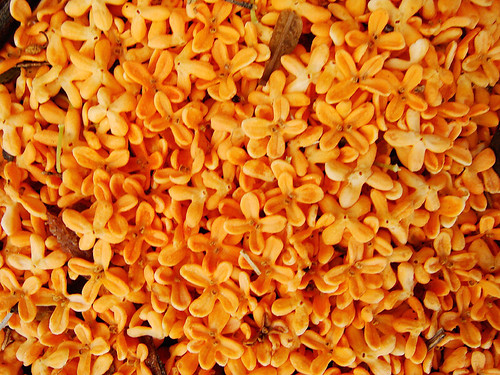
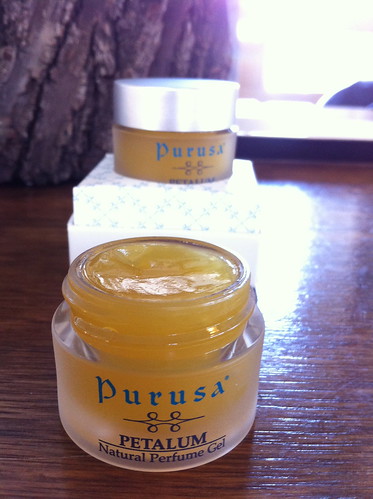
Purusa Petalum

   by gracias!
  , a photo by gracias! on Flickr.
The golden violet character of osmanthus is highlighted by sunny notes of mimosa and elemi and robust fruity-herbaceous davana (Artemisia pallens). Reminiscent of strawberry-jam, cured hay and grapes, davana adds a dark and fruity nuance to the apricot-leather quality of osmanthus, and shifts the balance from leather into fruit. Elemi's (Canarium luzonicum) lemon-pepper resinous note adds brilliance and clarity to this dense theme. It gives it a bit of a green and dry-woody tone as well.

Purusa Petalum by Sebastian Signs

Petalum is part of Purusa - Sebatian Sign's natural perfume gels line. They are infused into a smooth, easily-absorbing gel that's made from argan oil. Aside from the smooth consistency and unusual texture, they are also quite unusual perufmes, that style-wise fall somewhere between the therapeutic purity of aromatherapy synergies; and abstract perfume compositions of unusual notes.

Notes: Osmanthus absolute, jasmine absolute, davana oil, elemi oil, mimosa absolute. 
Back to the top