s

SmellyBlog

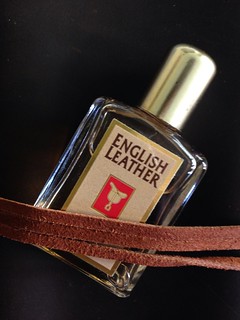
English Lather

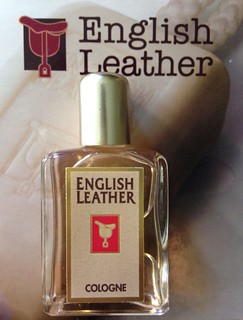
English Leather

English Lather... No. It's not a typo. To me English Leather smells more like soap than it smells like leather. And analyzing the notes (again - what I'm smelling, not what the marketing material tells me) makes it bubble-clear why.

English Leather opens with suede-like notes of tobacco leaf and ionones, which are reminiscent of violets where they occur naturally. These are mingled with plenty of petitgrain, which soon enough takes over. Therefore, the leathery association end pretty quickly. The reason is not only this note's inherent dominant character; but also because it's more likely the actual material used here is linalyl acetate. Underneath it all there is plenty of coumarin to give it a very powdery-soapy character.  It really is more of a fresh tobacco leaf scent than a leather fragrance. Curiously, it brings to mind another violetty masculine classic, Geoffry Beene's Grey Flannel, a scent that is only one year my senior. As far as violetty masculines scents go, I find Grey Flannel cloying and overpowering, and am much more fond of English Leather. As far as tobacco-leaf fragrances, I much prefer my very own Sabotage. And as far as cheap classic drugstore scents, so far Tabac Original and Old Spice (which is next up on my to-review list) are both unsurpassable.

I don't know how English leather is supposed to smell, but I was thinking about saddle leather more than suede gloves. I have expected to be transported to the tack-room, but instead was sent straight to the shower for a scrub before I even got a chance to get dirty at all... I have a feeling its formula got scrubbed a bit since it was first created in 1949.

English Leather - Soap On A Rope

"Wear English Leather or wear nothing at all", says the box of the Soap-on-a-rope.
This daring slogan cannot be taken seriously. But it sure adds to the fun of exploring drugstore and barbershop colognes. Personally, what I'd like to wear with it on what smells like just-showered-skin is my baby-blue flannel pyjamas... I suspect it will smell more alluring and bold on a man though...


So let's move over to English Leather's Soap-on-a-Rope. That's a triple-milled white soap, stamped with the stirrup and accessorized with a white rope handle, in a sizeable length, enough to bring to mind Hitchcock's film. I am not certain what the tope is for, so can only guess that either men lose their soap bars quickly; or that they like to hang them to dry on the shower-head. I really did buy this one with someone in mind as a giftee, so I don't want to crack it open completely (plus I'm not particularly fond of milled soaps - and much prefer the artisan cold-processed ones, which can be made in much less drying formulae). I will only comment on the scent and report that it's even more cologne-like and far less reminiscent of leather, suede or anything of the like.

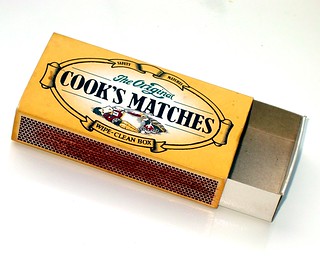
Matching

matchbox

There's a guy across the street in the retirement home, who must have lived a long, nicotine-rich life. He spends about half of the days asking passers by for light. And cigarettes. I gave him matches and lighters on a number of occasions, and even one of my cigars. Every time I have something for him his yellowing face lights up, he quiets down for a few minutes... and by the time I'm upstairs again I can already hear is yelling and soliciting for more tobacco.

Between Leather & Tobacco Week (May 11-15), the neighbour across the street asking for matches all the time,  and my newly found infatuation with Tabac Original - the natural course of events was to try to do matching for the latter.

"Matching this is the process of creating a replica for an existing perfume – it’s akin
to writing a symphony’s entire score by listening to a recording of it. nowadays, perfumers use a GC report to assist them in the process, but still need to rely first and foremost on their nose. matching is one of the most important skills for a perfumer, and one of the best tools to develop your composition skills, which is why you’ve been asked to create a match in many of the exercises throughout this book." (Foundation of Natural Perfumery, p. 176). 

Day at the lab

Matching is not something I do often anymore (I did a lot of it in my early perfumery days, as it's a great way to learn composition and study the classics, simultaneously). The reason I don't is because usually it's nearly impossibly to create something even remotely close because the bulk of the fragrance's personality comes from synthetics - some of which are not even naturally occurring. So it's a lost battle from the start. This is also why I refrain from providing any replication services for y custom scents.

Another great challenge of matching is to listen to your nose instead of the brain. In a way it's easier to make matching for something you don't know the name of, or anything about. This way you don't have any misconceptions about it, and that reduces the risk of the "power of suggestion" effect. With Tabac Original, for example: it's easy to assume that there is tobacco in there, and be tempted to add it in. It's in the name of the fragrance, after all! But even my keen nose cannot for the life of me detect the tiniest amount of actual tobacco notes in there. Yes, the fragrance may bring to mind tobacco because its clean, dry, woody character - but there is none of the acrid, leathery, hay-like or even violetty nuances you'll find in tobacco absolute. I'm not saying tobacco won't smell good in there. But it's just isn't there. It's almost easier to think of it as a Fougere - even though it's not that either (there is no moss that I can detect; nor coumarin, which pervades so many masculine fragrances of yore). 

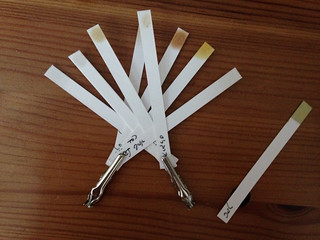
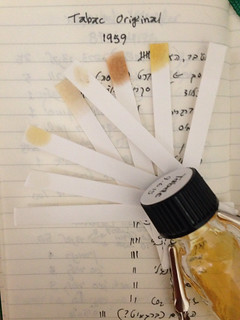
Matching "Tabac Original".

With Tabac Original - it seemed possible. Most of the perceptible and characteristic ingredients, except of the synthetic "white musks" are readily available on my palette. Plus, I thought it would be fun. The "brief" so to speak was not only to make it retain the refreshing vetiver and spice character, but also to refrain from using overtly rare or costly ingredients, so it could potentially be a  "natural drugstore" fragrance of sorts...

So far I'm rather pleased with the results - which utilizes Haitian vetiver as the key component, spiced heart notes of Egyptian geranium, petitgrain and allspice; top notes of lavender, black pepper, ginger and nutmeg. I also had to use some proprietary tinctures of ambrette seeds in lieu of the musk; and ambergris tincture as well to create a bouquetting effect. In that sense I failed to make it a truly cheap fragrance. But it seemed quite necessary for the composition if I were to avoid any expensive florals (for example: I decided to forego any neroli or carnation absolute, both being prohibitively expensive). The tinctures are used in minute amounts, but I won't say either of these raw materials is a run-of-the-mill, easy to find ingredient. It does smell great, though. 

Tabac Original

Tabac Original

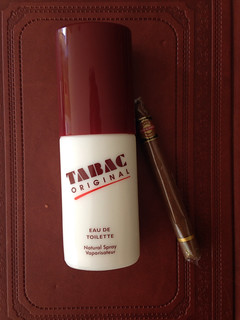
Tabac Original by Mäurer & Wirtz (1959) was ignored by me for many years after I took one whiff of it in my early days, and dismissed it. I can't even remember what was it that turned me off it - but I vaguely recalled feeling it was too overbearing and just let it remain on the shelf at London Drugs while I explored and rather enjoyed other cheap thrills there.

Years have gone by, and on a long-in-the-making hunt for men's drugstore fragrances, spearheaded by the absence of Old Spice, I decided to get a bottle of this one before it might disappear. Except for that vague recollection of the scent from many years past, you could consider it a blind buy. There was no justification for this purchase except that it had the word "Tabac" in it, and I just invested over a week of my life researching and teaching the topic of tobacco fragrances to my students. I figured - if I own English Leather, I might as well get this one too.

So last week, when the above mentioned acquisition took place, I arrived home carrying as many as four masculine drugstore classics, including an 800 mL of 4711 Echt Kölnisch Wasser, and being $90 poorer (for all four scents combined - the latter was the most costly of the bunch, at $54; Tabac Original was another high-end purchase at $24.99; the others were Old Spice and Brut, each at just over or just below $10). But I will tell you more about those later this week, as I go through the very limited and neglected bunch of masculine scents in my fragrance collection.

Because the other scents were already familiar to me (and some, like Brut, I could even just open and smell without any trouble returning them if I change my mind) - I decided to take my chances and that very same afternoon, sprayed myself (first hesitantly, and then rather lavishly) with Tabac Original. In essence, I was simply wowed by its originality, that I was able to quickly forgive the complete absence of any representation of "Tabac". There is no tobacco to be sniffed out in this fragrance, not even after a week of wearing it pretty much daily.

The opening notes are a delicious concoction of spices that exhale confidence, polished masculinity, and are pleasant and remind yet also bold and unusual. The spices all have a woodsy-dry character, which are most befitting for a masculine fragrance: Allspice, black pepper and nutmeg are at the fore, chased after by dry ginger, and this trio comes across as warm-dry yet invigorating (no pastry association, surprisingly). There is also some lavender, hints of pine, petitgrain and other citrus notes which gives Tabac Original its freshly showered skin, soapy accent, which  provides a beautiful contrast and balance to the spices.
Tabac Original

The lavender also adds an herbaceous, masculine floral nuance. The floral aspects are subtle, but can be also felt in the heart, where you might notice the clove-like presence of carnation, more soapy neroli, hints of geranium. But mostly what's present at the heart is an overdose of vetiver - or more likely, vetiverol - the vetiver alcohol that gives it the fresh and clean, tart-yet-sweet personality that is prevalent in Haitian vetivers more than any other variety. It's woody yet also gives off an almost juicy-citrusy feel, but also is very dry and elegant. This beautiful note is slightly balanced by hints of geranium, which also contributes to its masculine, dry-fresh and never overtly sweet character (even though if you'll notice - there is a lot going on here that could have made this sweet, if the perfumer only wanted it to go that direction). There is also a fair amount of alpha isomethyl ionone - which although does not occur in nature - it echoes the naturally occurring ionones in tobacco (though I am not sure I ever actually smell tobacco in there), and gives it some dry-violet, woody-floral nuances.

As we progress towards that base notes, the woodsy notes take over. And there isn't just vetiver - there is also cedar, and minute amounts of coumarin, which hint at the underlying flavour of a fine cured tobacco leaf, there is salty element too that is only vaguely reminiscent of oakmoss (there is non on the packaging, so perhaps they are now using evernyl, which is a very light and dry-smelling synthetic which vaguely resembles atranol-free oakmoss with non of its ambers-musky-mossy richness). But what really dominates the composition at the dry down is musk. And plenty of it. What we'd call "white musk", or the same musk combination you'd smell in musk oils that are sold in various shops offering fragrance oils (and often mistaking them for essential oils). Tabac Original thankfully develops this scent only many hours in, and until then it's mostly vetiver and spice and lavender goodness. It is one of the rare occasions when I care about the top and middle notes far more than the base notes - which I feel cheapen the otherwise superb composition.

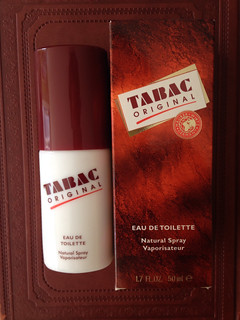
If it weren't for Tabac Original humble origins on the Pharmacy's shelf, one would think it's the latest niche release from any of your favourite houses. Which just goes to show you how far do image and marketing go. It could have easily come from another respected historical Italian pharmacy-fragrance niche line, bottled in a simple apothecary bottle with the titled etched in the glass; Or carry a British heritage about the barber great-grandfather inventing it for some royalty or another; On the other hand - if Tom Ford were to market it, there would be some closeup of his unshaven cheeks with erotic  suggestions of thick white lather, perhaps licked off by a couple of famished-looking naked models (their gender is yet to be determined). Instead we have a very humble packaging that might have seemed cutting edge and compteporary in the early 1960s, but now looks arcane yet honest:
"TABAC ORIGINAL Eau de Toilette is a modern fragrance with intensive lasting strength. Masculine, expressive, individual. A fragrance that underlines your personality" (quote taken from the back of the box for this fragrance). 

Tabac Original also comes in a variety of shaving and grooming products such as a shaving soap and an after shave (on which I can not comment meaningfully, because try as I may, my beard never develops to more than a stubble, and the moustache I sport is limited to Movember's paper touché). But a glimpse into one of those vlogs makes shaving look like a rather sensual ritual that I will look forward to in my next incarnation, in which I hope to spend my entire days lathering soap and playing with the foam for hours on end.

Top Notes: Black Pepper, Allspice, Nutmet, Ginger, Citrus, Pine
Heart Notes: Lavender, Petitgrain, Neroli, Geranium, Vetiver
Base Notes: Vetiver, Sandalwood, Cedarwood, Musk 

Pilates Mat Cleanser

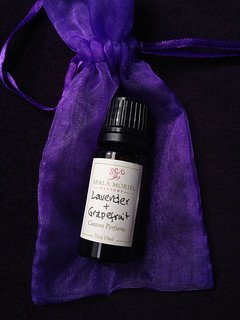
Lavender + Grapefruit

Last month I've attended two Pilates teacher training courses - Pre/Post Natal Pilates (via The Center for Women's Health) on the first weekend of May, and the last weekend of May my third (and last) module of the Trapeze Table, Chair and Barrels (via Balanced Body University) - both held at Meridian Pilates. So it's natural that Pilates is on my mind, and being who I am, I'm always thinking of ways to incorporate enticing scents into life, even if just in a functional manner.

Pilates studios share their space and equipment with many participants who hopefully break into sweat during the session, not to mention a fair amount of coughing and sneezing depending on the season. For hygienic reasons, each piece of equipment needs to be wiped out after each session. Most places use some random disinfectant or another. Few put any thought about the scent of these sprays, which is unfortunate. While in the smaller Pilates studios there generally does not seems to be an issue with participants not wiping the equipment - they will do so much more eagerly if the spray has a pleasant scent.

I've been to some places which used a combination of essential oil (usually tea tree seems to be involved - which is a good choice functionally speaking, as it combats all three microscopic enemies: bacteria, virus and fungi). It does not smell wonderful though. Most essential oils only target one or the other, or for the most just bacteria and virus but not fungi. The anti-fungal is important not just because no one wants to get Athlete's Foot, but also because most buildings here are essentially made of cheap plywood, and it's so wet here year-around that mould likes to settle in and take over, especially in the winter.

Therefore, it is nice to get a blend that can be added to a cleaning solution inside the spray bottles; but also used as is in a diffuser to also create atmosphere in the studio, get people to associate that scent with the feeling of rejuvenation and well-being they get at the end of the class and help them prepare for the session, and also address all those functional issues I mentioned above.

This past week I've sat down with some ideas of what my ideal scent for a Pilates mat spray would smell like, and worked on a few versions. The first (which you see in the photo) is an elegant combination of clary sage, lavender and grapefruit, supported by various Earl Grey tea-like notes and a few other herbal accents to make it smell less boring and simplistic. I wanted to create something soft and with a hint of more feminine nuances but still not too flowery or aromatherapeutic. I think it's a nice start, and the owner of the Pilates studio that inspired it all seems to like it. I hope to smell it next time I'm there cleaning my mat!

Orris: Flowers and Rhizomes

May Flowers
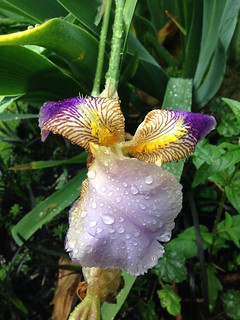
These purple iris flowers are an invasive species that are native to  as seen in Beaver Lake in Stanley Park, Vancouver. They are called Flag Iris (Iris psueudacorus) and also come in a yellow variety. Their rhizomes are not of any value to the fragrance industry but was used medicinally as an emetic, because of its high tannin level. It can be irritating to the skin and have an acrid taste. On the brighter side, it was used to clean water from heavy metals, as the roots has the ability of soaking these up and filter them out so to speak.

Iris germanica flower

These are the flowers of Iris germanica, which along with Iris pallida (AKA Florentine Iris, Sweet Iris or Dalmatian Iris) is a cultivar that is a descendant from the historic Iris mesopotamica which grows in the Middle East (it's a rare flower nowadays, but can be sighted in the Galilee in northern Israel). The flowers too have a wonderful aroma - which I'm surprised does not get featured in fragrances more often: it is buttery and soft, almost like white chocolate. But not yet powdery and dry like the orris butter produced from the root of the same plant.

The dried rhizomes of the wild plant was used historically for perfumes and cosmetic preparations from ancient times, what we now call Orris Root. The ground dried rhizomes were used in powders, and the chopped up roots in sachets and potpourri. Essential oil of the plant are one of the most costly perfume materials, and take 5 years to produce: the first 2 years, the plants are grown undisturbed, to allow them to develop the desired irone, which are responsible for their characteristic aroma. Then the entire field is uprooted, the rhizomes need to be washed and cleaned of all soil and sand, and peeled by hand. They are dried in a shaded area and are left to mature for additional 3 years, after which they will be ground to a powder and then will be steam distilled to produce what is known in the industry as "orris butter" - a buttery, powdery-waxy textured substance that has the scent of Parma violets, carrots and a baby's head and excellent fixative qualities that made it a staple in the European perfumer's organ. It is used in countless high-end fragrances, including all the Guerlain classics, at least in minute quantities in the signature Guerlinade accord, if not in higher doses as is evident in Apres l'Ondee, l'Heure Bleue and Shalimar. I've used it many of my fragrances for Ayala Moriel Parfums, sometimes in minute amount just to create that soft, diffusive, powdery quality, for example in Autumn, Cabaret and Espionage; or to accentuate the violet-like quality I was after, for example in Rainforest and Viola and Indigo. Other times, it can even be the star of the show (even if quite demure) as in Sahleb, which is practically an iris soliflore.

IMG_8562

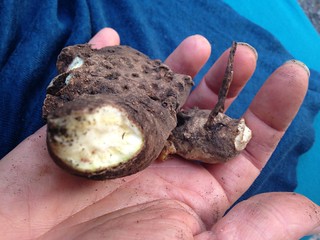
I've decided to experiment with this one piece of Iris germanica rhizome that I found in a neighbouring garden (they were hovering halfway above the ground, so I decided to pluck it away and see how the drying process goes).
First I washed them from all the dirt, using a mushroom brush to scrub it off the hidden places.
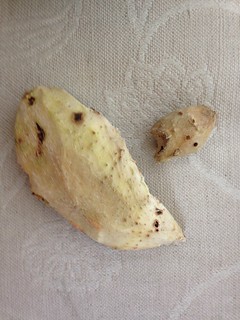
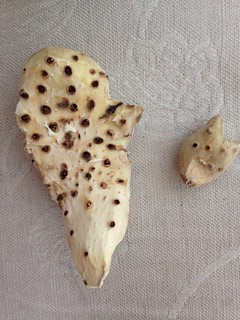
Then I used a potato peeler to scrape off the peel. And then I placed them in a dark wooden cabinet for drying and maturing...

IMG_8605

IMG_8606
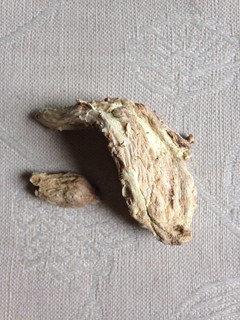
A week later, the bottom concave part of of it, which was sitting inside bowl, began developing a bit of mold hairs unfortunatley, so I had to peel that further. I changed its position so that it is as exposed to air and not inside a bowl but directly on the wood. It seems okay now and has dried up quite nicely already (just 16 days in) and has even began to develop a bit of the characteristic orris butter smell. I'm pleasantly surprised so far; and mostly thrilled to have a whole root that I could demonstrate to my students with.
Orris Root

Orris Root

Back to the top