
s

SmellyBlog

Hanami Sachets

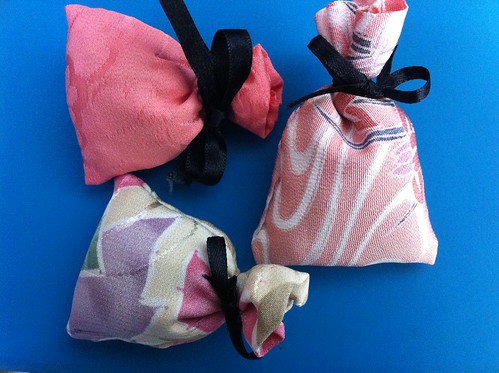
Hanami Sachets by Ayala Moriel
Hanami Sachets, a photo by Ayala Moriel on Flickr.
It only took me 2 years from when I received these incredible fabrics (vintage kimono silk) from Japan, to actually making and filling them.

They are hand-stitched (I still need to sew a few more), so very labour intense - a labour of love, if you will. But that's not the true reason for my procrastination. I just did not know what to fill them with!

The solution was partly serendipity, and partly luck. On my last day in Berkeley, I visited Yuko Fukami. She generously gifted me with high-quality Japanese herbs, spices and resins that she in turn received from our mutual friend Ross Urrere. In true Japanese fashion, she beautifully wrapped them with wax-paper, similar to how a TCM (Traditional Chinese Medicine) doctor packages his custom-dosed powdered "herbs" (for all I know, these can range from true herbs and plant matter to minerals and crushed sea-horses, tiger bones, dragon's tails and other mythical creatures body parts).
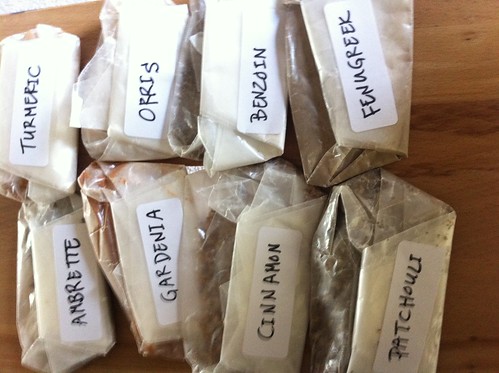
Japanese Spices, Herbs & Resins
Upon my return to Vancouver, I immediately set to mix together these glorious components, as well as some of my own stashed-away botanicals: dried ume (Japanese sour plum) blossoms, whole tonka beans, and others that for now will remain secret. Crushing the tonka beans with a marble set of mortar-and-pestle was a truly sensual experience. Although there is mostly coumarin in tonka, there is also something else that is nutty and spectacular that you just don't get from the isolate/synthetic molecule alone. I love it! French chefs grate it on microplane and add to chocolate desserts (ganaches, macarons, ice-creams...). In North America it is illegal to use it due to carcinogenic effects. Personally, I think that we are exposed to far more dangerous carcinogens in daily life (your seemingly innocent ink on your grocery receipts has a plastic that is highly carcinogenic, as are most cans used to preserve foods). So I don't feel bad at all making myself a tonka-dessert once in a blue moon.
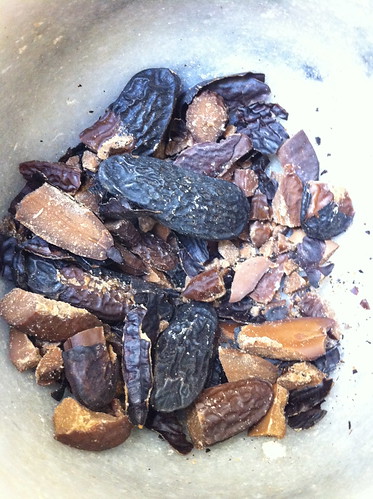
Crushed Tonka Beans
The sachets were supposed to be a studio-exclusive for my Hanami tea party. Unfortunately, we had to cancel it and will host it either in early May, or next year... So you can now get them online on my virtual boutique. These are very limited edition - I only have enough fabrics and filling for 12 sachets.

The Japanese used incense and sachets just like that to scent their kimonos and stationary so that they will be recognized for their good taste by their lovers (or suiters)... Use these sachets to scent your lingerie drawer, linen closet or stationary. You can also throw it in your suitcase when traveling, or tuck into a wool sweater or jacket's pocket for a lingering scent and to keep moths at bay.
Pain & Joy

"Pain travels side by side with joy and darkness is followed by dawn and another chance" (Judy Collins). 

It is true. The most joyful, blissful moments follow a rather painful experience. A great example is labour - followed by the greatest joy of all: the new life of your child. Likewise, the creative process can be a lengthy and agonizing one, not infrequently compared to giving birth - and ending in a creation that gives joy and healing to those who create it - as well as those who enjoy or experience the art, the audience.

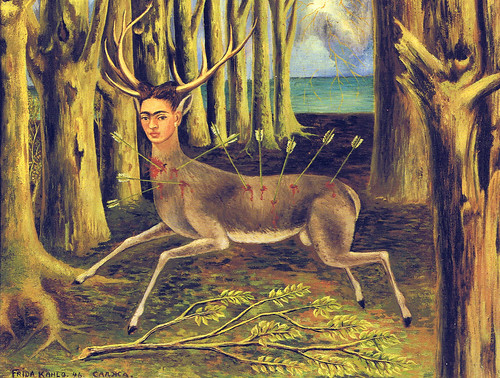
Many of the greatest artists have suffered chronic pain (Frida Kahlo is a prime example, as she clearly focused her art on the subject of pain, both physical and emotional), mental illness (Vincent van Goh, Ludwig van Beethoven, and the list is loooong),  at times also followed by addictions (Billie Holiday, Amy Winehouse), or some other kind of childhood illness or chronic disease that shaped their personality (Joni Mitchell, Hayyim Nahman Bialik) or a tragedy that made a mark on their life (Eric Clapton, Rudyard Kipling - both artists have lost their child) - and Judy Collins seems to have a taste of all... 

It is often debated - is perfume truly art? Is it a commodity? Considering that some of the greatest perfumes were created in response to the perfumer's own experience of pain, loss or unrequited love; or were inspired by such experiences of the designer that has commissioned them - I would argue that perhaps, after all, perfume is one of the greatest joys we can have - created through alchemical transformation.

Frida Kahlo - Self-portrait as wounded deer (1946) by petrus.agricola
Frida Kahlo - Self-portrait as wounded deer (1946), a photo by petrus.agricola on Flickr.

And what about ethics? Would the suffering of animals that were sacrificed in the process (i.e.: tortured civet cats, Canadian beavers hunted for their fur, sperm whales slaughtered for their blubber and ambergris, bees robbed from their honey and wax, and the extinct, massacred musk deer) be a contributing factor to the great beauty of perfume? This is perhaps digressing from the question, but from my experience, although the animal essences on their own reek of violence, fear and death - the result of adding a minute amount of this torture or death-extracts to a botanical perfume transforms it beyond imagination. 

This cycle of pain and joy is essential to our existence. Like breathing and sleeping, we need to learn to live with that and accept it, as we must accept the cycle of life and death, rejoice in every fleeting moment while we still live and breath, and cease the day to do what truly brings joy to us - because pain might strike at any moment. And we'll need to stock up on beautiful energy to go through it with dignity and compassion.

Cerise en Cocoa

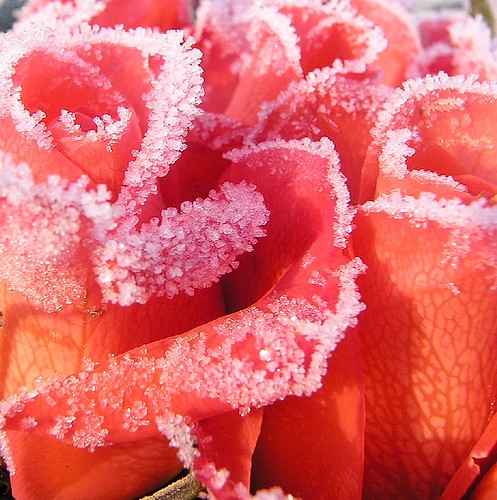
Eisrose 2 by multiflora
Eisrose 2, a photo by multiflora on Flickr.
Cerise en Cocoa is the other Rebel & Mercury's other osmanthus-laden perfume Nikki sent me to try before our osmanthus conversation, this time in an oil-base parfum concentration.

It is not nearly as osmanthus-y as Osmanthus Red, but is noteworthy for its stellar pairing of a difficult trio: rose, osmanthus and chocolate.

Rose and osmanthus together are extremely difficult to work with. When they have been paired in the past, the result was a rich-heavy-nearly-muddy concoction. Masterfully blended it will result in melancholy darkness such as that present in 1000 de Patou. Not so well done it is just sheer cacophony - every perfumer's nightmare.

Somehow, in Cerise en Cocoa, Nikki Sherritt was able to pull the best of each component and work them together in a balancing act that brings to mind an acrobat dancer on a tightrope. And not just any acrobat - but the legendary Rosa Marzipan herself (a beloved Erich Kästner heroine). Pretty and flexible, with a delicate almond-paste complexion and while her head is nearly always in the air, her head is grounded in reason and wit.

Cerise en Cocoa (cherry and cocoa) begins with a burst of unusual fruitiness - the plum-like, robust juiciness of osmanthus absolute combined with an even juicier ruby-red grapefruit zest and both bring forth the the peach-plum damascones in red and white roses. The wine-like, liquor qualities of cocoa absolute also contribute to the sensual feeling of biting into a Pierre Herme violet-cassis macaron, with the thin brittle skin bursting open to reveal a lightly fragranced, creamy almond paste underneath and a cassis-flavoured silky ganache undnerneath.

Yet, all this apparent sweetness is well-balanced with an underlying dry air of woodsy vetiver roots. There is almost a dry feeling of pencil shavings, so there might be some Virginia cedar lurking beneath too.

Cerise en Cocoa is available directly from Rebel & Mercury's Etsy shop; or via Sweet Anthem in Seattle.

Top notes: Ruby Red Grapefruit, Virginia Cedarwood
Heart notes: Osmanthus, White and Red Rose accord
Base notes: Cocoa, Vetiver

Vetiver Rouge OOAK Perfume

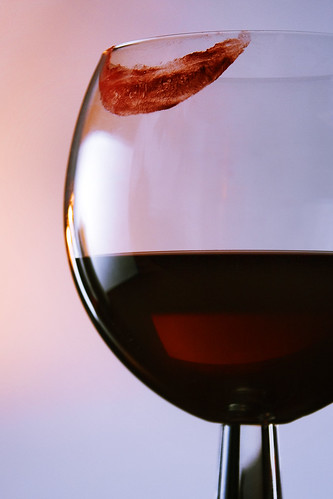
Lipstick by 96dpi
Lipstick, a photo by 96dpi on Flickr.

And while we are on the theme of red, I want to announce a new One-Of-A-Kind perfume I recently added online. Back in 2007, I was on a vetiver roll and created several vetiver-centered fragrances. Out of these, my favourite, Vetiver Racinettes, was added to my permanent collection of natural perfumes.

However, the road of vetiver was as fascinating and quirky as the finished result - 5 different mods, Wilde Vetyver, Vetiver Blanc, Vetiver Noir and a Vetiver Truffle - a solid perfume with black summer truffle oil that melds together the luxurious and the earthy. Six years later, I returned to the sketch book of the 4th in the series, Vetiver Rouge, and felt inspired to elaborate on the theme of red vetiver.

This time around, I've played with the meaning of the name, and took it to the complete opposite direction than my other vetiver scents. It is far more soft, round, sweet and feminine. While is still maintains the mysterious depth and complexity of the darkest of vetiver essences, it had the audacity and It has the red spectrum with notes that in my mind have deep reddish hues.

Complex and ambitious, the most tenacious vetiver notes from around the world are accompanied with the elusive, distinctive, intensely licorice-sweet and somewhat powdery - tarragon absolute. The red-copper tainted Ruh Khus from India is combined with a co-distillation of vetiver with Mitti attar (baked Indian earth) and juxtaposed with the earthy luxury of deep cacao liquor. Add to that a slice of juicy, raspberry-like blood orange, red rooibos red tea, geranium absolute from the tropics, red champaca absolute and exotic tomar seeds form India, and there is a concoction that is like a kiss of thick rouge and a sip of a deep red wine.

Notes: Attar Mitti, Blood Orange, Champaca, Cocoa Absolute, Davana, Geranium Absolute Ginger, Nutmeg, Rooibos (Red Tea) Ruh Khus, Tarragon Absolute, Tomar Seed, Vetiver Indonesia, Vetiver Sri-Lanka, Zantoxylum

Osmanthus Red

Osmanthus Red by Rebel & Mercury paints osmanthus in broad strokes of magenta, red and gold. While most mainstream osmanthus scents are painted in faint, washed-out watercolours, Nikki Sherritt prefers to paint hers in full-bodied oils that give a thick, almost syrupy texture to this rare absolute.

Osmanthus Red pairs the plum-like and "violet meets blackberry jam" quality of osmanthus, as the perfumer described she perceives it in our previous conversation - with juicy blood orange, and the golden hues of marigold (aka tagetes - pronounce tah-jet), a modest garden flower that keeps hungry caterpillars at bay, and gets little attention if at all from perfumers. Marigold on its own has a slightly citrus opening reminiscent of bitter orange zest; but it is most significant for its overripe Golden Delicious apple-like notes and almost-disturbing green bit of leafy overtones; yet ends with a soft, very natural, herbaceous-sweet grassy, hay-like finish. It's a little like tomato-leaf: you'll either love it or hate it. And who besided Nikki would have imagined that such a strong-minded note will get along so well with the elusive and distinctive osmanthus?
Another prominent note in Osmanthus Red seem to give a nod to the Asian culture from which this plant originates: ginger CO2, which is full-bodied and as golden as could be, almost candy-like. Tuberose gives it an animalic edge, yet with a feminine softness, which leads us to the most alluring, voluptuous amber base, lingering for hours on end. It's honeyed, a tad powdery and very long lasting, as a good amber should be.

This is the Eau de Parfum I'm writing about. It is also made in an oil base. Other sizes are also available from the Rebel & Mercury online shop.
Back to the top