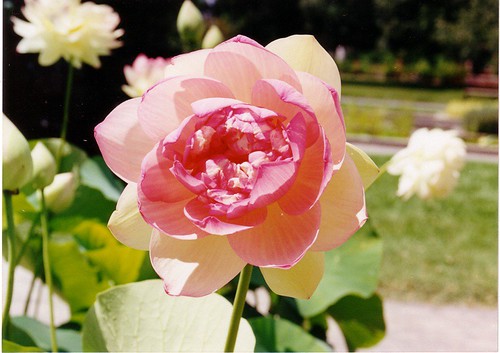
The lotus is an important symbol in several Eastern cultures. There is an ancient confusion between two equally beautiful and elusive water flowers: the true lotus (
Nelumbo) and the water lily (
Nymphaea). However, both carry very similar meaning symbolically and spiritually. Both plants grow out of the depths of mire and rise above them with a blossoming purity. The flowers in both cases possess an impressive visual appearance and a corresponding intoxicating perfume.
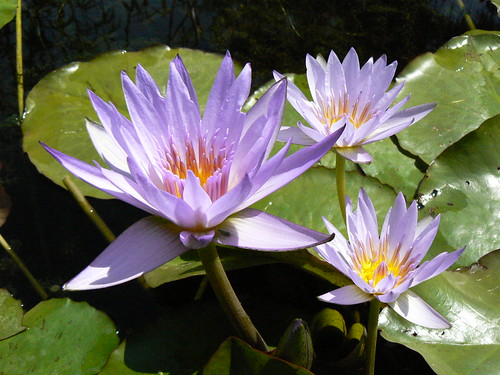
Let's begin with Ancient Egyptians, who referred to the so-called "blue lotus" (
Nympheae cerulea) really a blue water lily) with much reverence. In Ancient Egypt blue lotus was abundant all around the Nile Valley. Nowadays, it is a scarce plant that grows in marshes and ponds in that area. The flower blooms only for 3 days, in which it rises 20-30cm above the water, opening around sunrise, between 7:30-8:00am and closing around noon, a cycle that echoes the solar rising and setting.
To the ancient Egyptian imagination, the yellow centre with its shooting yellow stamens set agains the blue flower symbolized the sun set in the azure Egyptian skies, and associated the "sacred lily of the Nile" with the sun god Ra. Blue lotus plays a role in an even earlier Egyptian myth - a myth of creation, which tells how the flower rose from "Nun" - the chaos - even before the sun itself was created.
"I am the pure Lotus which springeth up from the divine splendor that belongeth to the nostrils of Ra. I have made--my way--, and I follow on seeking for him who is Horus. I am the pure one who cometh forth out of the Field." (The Papyrus of Nu). Garlands of blue lotus were found in tombs and are portrayed and mentioned in the Book of Coming Forth by Day (AKA
Egyptian Book of the Dead) - the guide for the soul in the afterlife. "Transformation Into Lotus" is described in both in the papyrus of Nu and the papyrus of Paqrer. Blue lotus was also found in countless frescos and decorations on various ritual chalices. The priests would steep the flowers in wine and harness its narcotic and hallucinogenic properties in their rituals to reach a state of ecstasy. The flower's naturally occurring amorphine, nuciferine and nornufcferine are what give it hallucinogenic properties.
Blue lotus is not the only waterlily grown in Egypt. There was also the white waterlily (Nympheae lotus) which blooms at night and had only aesthetic use.
Flower of Enlightenment 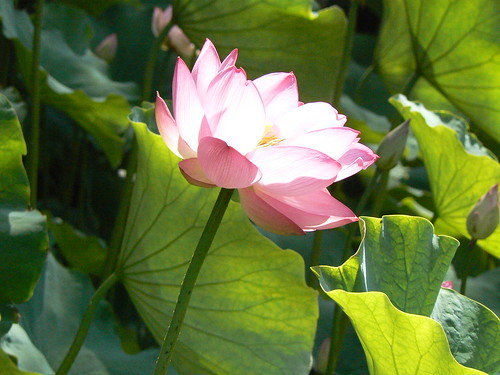
Another noteworthy waterlily is the Indian Blue Lotus (Nymphaea stiletto), which is sacred to the Buddhists and the Hindus. Buddha is said to sit on a lotus (Padma), and practitioners of meditation and yoga prefer the
Padmāsana (AKA Lotus Pose), which literally means "lotus throne", a position that allows a completely straight spinal cord, redirect the blood flow from the legs to the belly, and creates pressure on the lower spine which along with the still position, initiates a calmer state of mind and provides less physical distractions while meditating. The lotus is also a symbol to the
Sahasrana, the crown chakra, which has 20 layers of 50 petals each, in all the spectrum of colours.
The Buddhist consider lotus a symbol of Dharma (creation). In Hindusim, the lotus symbolizes the transformation from decay and transcendence above one's muddled material existence to achieve something greater. Interestingly, Hindu mythology also consider lotus to be the home of their sun deity.
"There is no need to distinguish between lotus and the waterlily because it is recorded in the sutras 'the lotuses of heaven can change according to people's wishes, flowering when needed'. In this way, they bring joy to the hearts of all. There is no need to declare one false and the other real. both are called the wondrous lotus flowers" (Roman Keiser, Meaningful Scents Around the World p. 121).
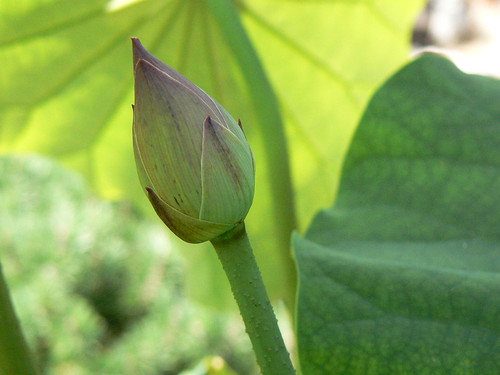 If the lotus flower is enlightenment, lotus bud is the potential for the unfolding of the thousand petals.Merging the Spiritual and the Fragrant
In my early days as a perfumer, I was guided by an insatiable thirst to harness the aromatic potential of plants in spiritual practice of meditation and incense-making. The Perfumes of the Zodiac were part of this process of my spiritual quest, as they are truly a study of human personality in all its many nuances and variation. This was the first collection I created. Lotus was the connecting link between two of the three water signs:
ScorpioScropio is the most firey water sign of all. If Cancer is the deep and wide ocean with all of its tides and waves, and Pisces is a babbling brook – than Scorpio is a deep, dark lake in the throat of a lava-mountain, bubbling with heat deep down. Scorpio signifies transformation, and therefore, the essence of lotus is particularly fitting for this perfume. Lotus being a beautiful, pure and fragrant, sacred flower that rises from the dirty swamps of decay and darkness. Other essences in Scorpio Perfume were chose for their association with Mars and the warlike qualities it represents: opoponax, choya loban (burnt benzoin), black pepper and blood orange. I also chose tuberose for its intensity and for supporting the fragility of the lotus flower.
Pisces
If water means change, than Pisces is the epitome of water. It is changeable and mutable and lively like a cheerful little fish swimming in the brook – sometimes upstream, perhaps… Pisces is intuitive, spiritual, sensitive and emotional. Like Sagittarius, it is ruled by Jupiter.
The essences I chose for Pisces are moist and mossy, and being the end of the zodiac year's cycle are not unlike the decaying of leaves in the forest, on which new vegetation will strive.
Oakmoss, seaweed, amber, juniper, jasmine, lotus and sage make Pisces a simple yet interesting Chypre composition that has salty undertones.
Lotus HarvestLotus harvest - photo courtesy of Christopher McMahon of White Lotus AromaticsLotus originates in Kashmir, but has travelled with the monks all over Southeast Asia. It grows wild in the ponds of the East Indian jungles. Unlike modern Western perfumers, the East Indian perfumers actually distill their own essence. They are in touch with the plants in their original raw state, and at times even pick them from the wild. Using a light, portable copper still, the perfumer can carry it on his back while entering the wilderness to collect flowers in their blooming season, be it from the coast, the jungle or the pond. To harvest both the lotus and water lily, the perfumer must immerse themselves to the waist in the very murky waters from which they've ascended.
"Lotus Effect"
The surface of the lotus is observed on leaves that have water-repelling (
ultrahydrophobic) properties. What happened is that the water slides off the leaf and cleans it from impurities such as dust, dirt, etc. In effect, this is a self-cleaning mechanism of the lotus plant, as well as many other superhydrophobic leaves. This is what creates the impressive effect of perfectly pearly drops of water on certain leaves.
Medicine and MythHomer's Odyssey tells us about the "Lotophagi" or "
Lotus-eaters" - people who live on an island full of lotus plants, and who rely on it entirely for nourishment. As a result, they are in a constant state of peaceful slumber and comfortable oblivion. Perhaps he was referring to the ancient world's junkies: lotus flowers are a hallucinogenic. The Egyptian steeped the blue lotus flowers in wine to create a narcotic concoction that was used by priests in sacred rituals.
Lotus leaves have interesting chemistry, that makes them
potentially valuable for medicine, with the following properties (please do not interpret any of the following as medicinal advice or prescription - they are intended for your botanical and cultural interest only):
Astringent; Cancer; Cardiotonic; Febrifuge; Hypotensive; Resolvent; Stomachic; Styptic (and used to treat various conditions such as excessive bleeding); Tonic; Vasodilator. In TCM, it is also considered an aphrodisiac, calming and cooling, nutritive tonic, nervine.
However it does not seem like this potential was utilized yet in modern medicine. All parts of the lotus, but particularly the root and seeds, remain a core ingredient in
Traditional Chinese Medicine.
The following are some examples for medicinal applications of various plant parts which I have gathered online. Most of the medicinal preparations are
decoctions - method of extraction in which, much like the traditional brewing pf Turkish coffee, the plant matter is boiled to dissolve its active chemicals. TCM uses both the rhizomes or leaves, usually in conjunction with other herbs, to treat "sunstroke, fever, diarrhoea, dysentery, dizziness, vomiting of blood, haemorrhoids. The whole plant is used as an antidote to mushroom poisoning" (Source:
MDidea).
Leaf: juice from the leaves is used to treat Diarrhea. TCM
Flowers: a decoction is prepared from the flowers and the flower to treat premature ejaculation and as a cardiac tonic; and from the flower's receptacle (torus) to treat abdominal cramps and bloody discharges. TCM use the pounded petals for syphilis. In Java they are also used for cosmetic unguents.
Flower Stalk: Haemostatic (stops bleeding), and used in instances such as leading ulcers, heavy menstruation and postpartum hemorrhage. TCM uses the flower stalk with other herbs to treat uterine bleeding.
Stamens: Diuretic, urinary frequency, premature ejaculation and uterine bleeding.
Fruit: fever and heart complaints.
Seeds: Hypotensive, sedative and vasodilator. Contain flavonoids and alkaloids. Lower cholesterol levels and relax the smooth muscle of the uterus; Poor digestion, enteritis, chronic diarrhea, insomnia.
The plumage and radicle are used to treat thirst in high febrile disease, hypertension, insomnia and restlessness. In TCM, the seeds are considered a "cardiac tonic, seminal tonic, astringent, sedative, refrigerant, strengthens kidneys, clears phlegm, clears inflammation of eyes" (Source:
MDidea).
Fresh Rhizomes (often called "roots"): Cooling when eaten raw, stimulate the appetite when eaten cooked
Rhizome Starch: Diarrhea, dysentery. Taken internally in the treatment of hemorrhages, excessive menstruation and nosebleeding.
Root Nodes: Nasal bleeding, haemoptysis and functional bleeding of the uterus.
Culinary Lotus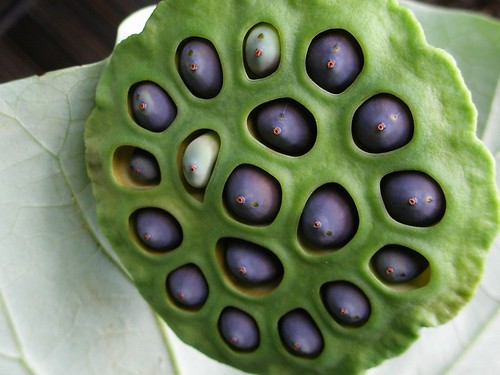
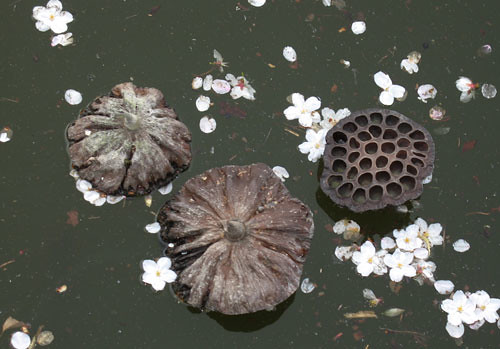
These images of the fresh, full bods and the dry empty ones equally spark my imagination. The dry pods are sometimes also found in floral shops, sold on their stalks for long-lasting bouquets.
One of my favourite dim-sum treats are sesame balls that are filled with delicately sweet black paste made of lotus seeds. The seeds are not easy to come by (I will have to make a point to hunt for them on my next trip to Chinatown), and I have only experienced them in desserts; but they can be used in a versatile range of
recipes, both savoury and sweet, i.e.: as a filling for sweet festive cakes such as mochi and sesame balls, puddings, Indian sweets, curries, and roasted and puffed for snacking.
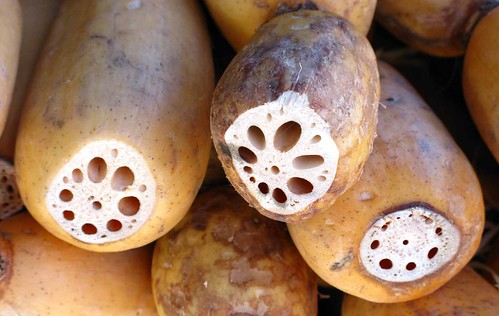
In contrast to the flavourful seeds, lotus "roots" (botcanilly speaking they are the rhizomes)
are rather bland. Their value is more visual - having a pretty flower-like shape when sliced. They have a crunchy texture and a mildly starchy vegetable taste, very much like that of bamboo shoots of palm hearts. They are used in hot pots, stir fried, deep fried like tempura, or even like a crispy alternative to chips.
Lotus Aroma ChemistryAccording to Roman Keiser (
Meaningful Scents Around the World), the blue water lily's headspace reveals the following constituents:
Benzyl acetate, anisyl alcohol, (E)-cinnamyl alcoho, cinnamyl alcohol, and derivatives of (E,E)-undec-5-en-2-ol: (E)-undec-5-en-2-one, (E)-undec-5-en-2-ol and their corresponding acetates, alpha ionone and beta ionone.
White Lotus has 1,4-dimethoxybenzene, which gives it a rather unpleasant medicinal aspect. Hybrids with the Yellow Lotus, AKA Amriecan Lotus (
Nelumbo lutea) breed a more pleasant aroma, as they contain also jasmine and methyl cis-(2)-jasomnate.
Organoleptics of Various Lotus Absolutes: 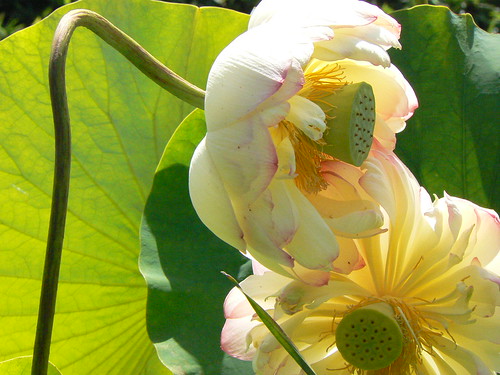 White Lotus
 has a powdery, earthy, dark floral, exotic, strange, dense aroma. Reminiscent of tuberose absolute. Sweet yet subtle with a tad of nutty and mushroom-like quality and hints of anise. Reminds me of old, well-worn silk garment. Dominated by medicinal, warm-herbaceous sweet odour of 1,4-dimethoxybenzene
Pink Lotus is sweet, silky, fruity, intense yet subtle. The rich, over-the-top floralcy is to me a very Indian smell - bringing to mind scouring through my friend's parent's collection of little vials of Indian perfumes.
Blue Lotus (or Blue Waterlily) is a sheer, light woody-floral, nutty, musky, aquatic/watery, subtle, slightly green, refreshing, hyacinth-like, violet-like, sweet-aromatic, clear, light, effervescent, ephemeral.
Both the white and pink lotus absolutes are a dark orangey-brown viscous liquid, and with highly staining qualities. The blue lotus absolute is a clear light green viscous oil.
Lotus in Perfumery: Lotus is a rare and costly raw material and is only rarely used in its natural form. Most "lotus" perfumes you'll find out there bare very little resemblance to neither the living flower nor the absolute extraction, and customarily belong to the yawn-inducing aquatic floral fragrance family. Traditional Indian perfumers and modern natural perfumers are the only ones whom I know still work with the true lotus and create authentic perfumes that resonate with the spiritual and esoteric layers of the flower - which is inevitable as this is such a weird, complex and rare raw material. It is very rich and can easily clutter a perfume is used incorrectly. However, when it is used in tune with its aromatic and spiritual properties the results are quite astonishing and versatile: it is incredible beautiful and haunting in chypre compositions, where its musty, mushroomy origins are accentuated. On the other hand, when used sparingly and in the right environment, it can create a shimmering, effect that brings to mind the delectable waterlily-like perfume echoing the blue skies from above, or working in conjunction with narcotic, sweet or fruity florals to create a rich tapestry of odours.
Perfumes with noticeable lotus note:Pink Lotus:Blue Diamond (Setphen Arctander - created in 1979 and discontinued for many years)
Coeli (Ayala Moriel Parfums) - discontinued
l'Écume des Jours (Ayala Moriel Parfums)
Gypsy (Providence Perfume Co.) - discontinued
Hanami (Ayala Moriel Parfums)
Itoh (Mikmoi)
Pink Lotus (Aftelier)
Scorpio (Ayala Moriel Parfums - discontinued
Waterflower (Soivohle)
Blue Lotus:Arunima (Strange Invisible Perfumes)
Blue Lotus Oil (Soivohle)
l'Eau d'Issey (Issey Miyake)
Lotus Blossom & Waterlily (Jo Malone)
Lumieré (Aftelier)
Lyric Rain (Strange Invisible Perfumes)
Naima (Ayala Moriel Parfums)
Nymphaea Cerulea (Régime des Fleurs)
Purple (p)Rose (Ayala Moriel Parfums)
Secret Garden (Aftelier)
White Lotus:Misetu (Soivohle) - discotninuted
Padme Lotus (Dawn Spencer Hurwitz)