s

SmellyBlog

EauMG Reviews Sandal Ale

"Sandal Ale smells like a sandalwood Indian Pale Ale (...) it’s effervescent and fizzy like an apricot pale ale with a shot of spicy ginger beer (...) this perfume completely surprises me. It’s this warm, spicy sandalwood that is woodsy but somehow delicious with a cool, refreshing elderflower liquor. And there’s a sheerness to it that makes it refreshing, like a cold pale ale on a hot day. It’s like a “splash of sandalwood”."

Visit EauMG to read the rest of Victoria Jent's review of Sandal Ale, my newish release from 2014 that melds together and celebrates sandalwood and craft beer.


Fresh Nose


A huge part of my work is educational, either spontaneously via interactions with customers and random encounters at social events; or intentionally through workshops and classes I offer. 
This past winter holiday season, I had a blast interacting with children at a Christmas show last year. Unlike their parents, they're not spoiled yet with misconceptions against fragrance (like so many folks in Vancouver - everyone claims to be "allergic", where in fact they are more like just ignorant and close-minded). These children's curiousity and sheer delight at smelling something new was so refreshing that it stuck with me for months after the fact! 

Time and again, I meet adults that are so jaded about perfume (and probably life in general). They act like they've seen it all, even though it is more likely that they are too scared to step out of their comfort zone and experience anything new. How many times have you met someone who just jumps at the opportunity to rather than just claim that they "live life to the fullest" (a cliché I hear so many times that I want to scream and run for the hills), where in fact, they just want to do the same thing over and over again because they identify with the notion of being "au naturele" or whatever their rational or made up ideology is behind not wearing fragrance is.

Back to those sweet kids: their enthusiasm was heartwarming and their natural curiousity was inspiring, to say the least. I had two main encounters with them that stuck with me. One was with two friends who were about seven or eight years old. They smelled and tried different perfumes and when one of the girls inquired about price, she wasn't discouraged because she could not afford it (the point when most adults glide their gaze elsewhere and remove themselves as swiftly as possible from my booth) - but was excited that she can try it on. I also mentioned to her the price of the samples, in case her allowance might be closer to that. The other girl, who was by then exploring the tucked-away Zodiac line, came back after a few minutes, and asked me if Taurus had a sample... So sweet! Of course I sent them off smelling heavenly and gave them pretty postcards and scent-cards with some of the scents they liked.

The other pair were a brother and a sister, probably about ten and eight, respectively. The girl was smelling and enjoying the display of testers, while the boy went on and on with questions about how perfumes are made, how oils are extracted, whether or not I grow the plants and distill them myself, all dotted with clever attention to detail and more interesting questions than many interviewers in professional magazines ever bother asking. I was hoping they will never leave my booth because the rest of the show was mind-dumbing boring, thanks to the uninterested crowds.

And then there was a woman older than my mother, who visited the booth and was probably more excited about the notion of having a perfumer in the city than any other person I've ever met. She sat there for hours, sniffing, sharing stories, swooning in pleasure and near-ecstasy elicited by the scents I've created (what an honour!) and inviting anyone who as much as peeked at my room to come in and marvel at the rarity of the opportunity of meeting the perfumer who created them.

While I'm more than just a tad tired and bitter about the current state of affairs in my city during craft and holiday shows, and in particular what seems to be like a pathetic downhill tumbling of the city's culture thanks to the sense of entitlement so many people seem to have whenever they interact with one another -- I am most thankful for these three occurrences of graceful interaction with future generations and with the lady who truly appreciates perfume. Don't ever underestimate what a kind word to an artisan or a small business owner can do. They might just decide to not quit thanks to you!

February Giveaway: NARCISO

Half of February has already passed, and I now realize I haven't even posted my giveaway for this month... Time flies!
So, for this month we've got a little Narciso beauty pouch with a scented body lotion, as well as eau de parfum spray samples of this fragrance.

Reminder for the rules: Each month, blog commenters (on all and any post) will be entered into a draw on the first day of the following month. The winner is selected at random. You must respond via email with a mailing address in order for me to be able to send you the prize. If a prize is not claimed,  it will go to another random commenter, or will be offered again at a later time. Winner who have already won something in the past 12 months will not be entered into the draw.

Tuberose Pommade and a Flower Meditation


The other enfleurage pommade I ordered from Dabney Rose was a tuberose one. If you've smelled fresh-cut tuberose before, you'll be appreciate the glorious beauty of the living flower that has been captured in the vegetable oil base of this pommade. You can read more about the process and what pommade means in my post about the equally stunning Butterfly Ginger pommade.

Capturing a living flower's true scent is an enormously challenging feat. Dabney Rose does an incredible labour of love growing her own plants in a glass hothouse and her own little garden, and she must be tending to each blossom and petal with much care while growing them, and of course handpicking and placing them in the coconut-base vegetable alternative to enfleurage.

The Tuberose Pommade brings to mind spring eternal when the entire room is intoxicated from a single cut stem. It transports you to a hot summer night on the beach, adorned with a lei of tuberoses and gardenias. I am yet to experience this in real life, but my imagination is quite satisfying and a dab of real tuberose is enough to make it feel real. All is needed is to close one's eyes and surrender your senses to this beauty, for it is fleeting.

The pommade is not a solid perfume, but a pure, single note extraction - a rather antique method, like the one invented in the city of Grasse. It does not last long, which demands you do pay attention to it while it lasts. With such rare beauty, a floral meditation is in order, once you apply this white unguent to pulse points or even finger tips. Take a few moments off your stressful day to appreciate this beauty. Or better yet - start your day that way. Dedicating the beginning of your day to gratitude and appreciation is the best way to start the day. Invite life's blessings and pause to fully appreciate it, and more will come your way.

Almonds for TuBishvat

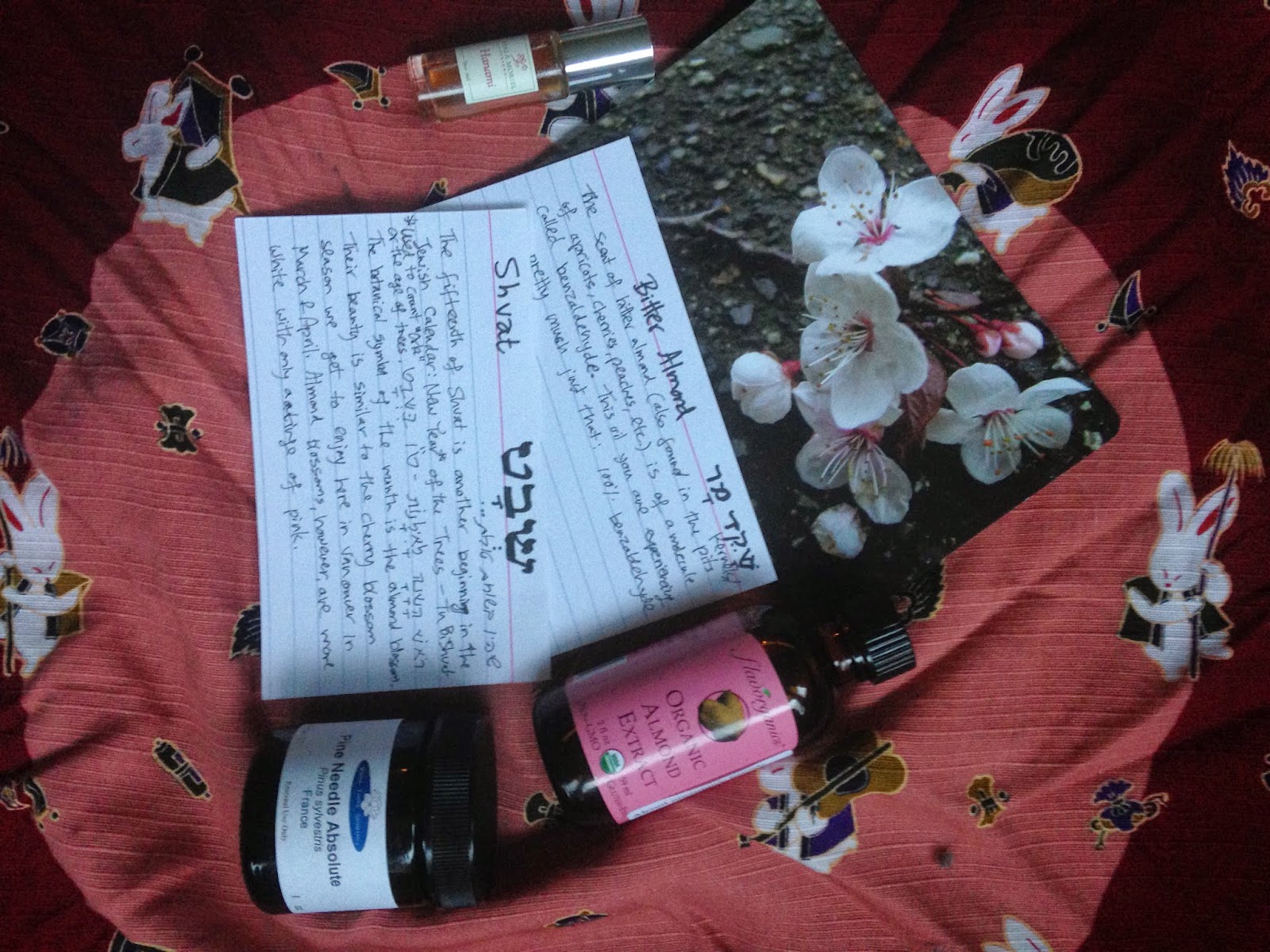
Today is Tu BiShvat - the new year of the trees. And what better essence to celebrate than that of almond? This year I have finally got my paws on bitter almond oil. It is a very simple essence, and can technically be considered an isolate, as it is nearly 100% benzaldehyde, the simplest aromatic aldehyde, comprised of a benzene ring and a formyl substituent.

Benzaldehyde smells almost cloyingly sweet - which is funny coming from what is generally called "bitter a almond". Benzaldehyde was first extracted in 1803 by the French pharmacist Martrés, and in 1832 synthesized by German chemists Friedrich Wöhler and Justus von Liebig.

It is extracted not just from the bitter, and largely inedible type of almonds (which have a dangerous proportion of prussic acid, AKA cyanide) - but also from the kernels found in apricots, cherries, peaches, plums, apricot which have a more delicate but still bitter taste and that unique aroma of benzaldehyde. Apple, quince and pear seeds also have small amounts of benzaldehyde, and it is also naturally occurring in oyster mushrooms, cinnamon root and bark, champaca, patchouli, cassia, orange blossom concrete and cassie concrete.

Bitter almond oil is mostly produced in the USA, Israel, Syria, Turkey, Morocco, Spain and France. To extract bitter almond oil, the press cakes from the bitter almonds (Prunus amygdalus var. amara), or kernels of apricots, plums, peaches or cherries (an easy raw material to come by, as a by-product of the fruit canning process, and after their fixed oil has been removed - mostly for the cosmetics industry) are soaked for 24 hours. This soaking allows for an enzymatic process to occur, that will break down the amygdalin in the kernels and initiate the formation of benzaldehyde and hydrocyanic acid (cyanide). Of course, the latter must be removed (by alkali washing and rectification), due to its lethal toxicity. As to be expected, non of the almond oil used for perfume or flavour contain any cyanide. Curiously, although cynadine and benzaldehyde share no commonality in their molecular structure, they both have a similar aroma. You may have come across the smell of almonds in numerous detective and crime novels.

Bitter almond smells like marzipan (or almond paste), is highly volatile and unstable, and is more popular in favouring than in perfume - though preferably, it should be fixed by adding alcohol, vanillin or anise alcohol, among others. Besides its extensive use in baked goods (i.e.: in almond filling for frangipane tarts and almond croissants, for example). Curiously, the taste of this oil is sweet, not bitter (the bitterness is from a non-volatile ingredients, and it disappears when exposed to the water during the distillation process). Bitter almond oil is therefore used as a sweetener when composing flavours such as apple, apricot, cherry, pistachio, raspberry, almond, and more.

As far as perfumery uses, bitter almond adds a sweet, gourmand note whenever one wants to have a marzipan-like quality. It also is a great additive to violet, mimosa, cassie and orange blossom. It pairs beautifully with anise, cacao absolute, cassie absolute and vanilla.
It's important to note that nowadays, mostly, synthetic benzaldehyde is used. A telling sign that a "Bitter Almond Oil" is in fact synthetic benzaldehyde is the notion of FFC on the label of "Bitter Almond Oil", which stands for "Free From Chlorine" - chlorine only turns up in the process of synthetic manufacturing of this component, and must be removed for flavour and food preparations. If the label says "FFPA" (which stands for "Free From Prussic Acid") that means that it's from a natural origin (i.e. the kernels mentioned above).

Back to the top