

s

SmellyBlog

The Mystery Behind "Perfumed Teas"

The curious question of how exactly were my teas "perfumed" gets brought up often. Contrary to the intuitive (yet outrageous) guess that a perfumed tea is made by a mad perfumer who likes to dip their tea bags in perfumes - ther term "Perfumed Tea" is a rather ancient concept in tea culture and not nearly as dangerous as it may sound.

If the term "Perfumed Tea" seems mysterious or strange, I would attempt to clarify and shed some light on this enchanting phenomenon in tea culture that I have becaome aware of thanks to my collaborations with Dawna Ehman. Perfumed Tea refers to a tea that is flavoured with the true and pure plants and flowers. Rather than get their aroma and flavor from artificial and natural flavouring essences (which is what the more commonly consumed and often tea-bagged Aromatized Teas are all about), Perfumed Teas are perfumed with fragrant plants, fruits and flowers. For instance: a perfumed jasmine tea is made by layering tea leaves with fresh jasmine flowers and replacing the flowers with new ones until the tea is completely immersed with the jasmine's aroma.

The Perfumed Teas in the Ayala Moriel collection are perfumed with the raw plant matter that was chosen for its unique aroma and flavour profile - all selected and proportioned carefully as to represent the perfume in the form of tea.

For instance: Tirzah tea is perfumed with linden flowers and osmanthus blossoms among others, to bring across the fresh, green floral notes of the perfume of that name.
Immortelle l'Amour tea has vanilla-infused rooibos. The vanilla beans are present in the tea blend itself, and when you finish your cup you may find some vanilla specks at the bottom...
And lastly, Gaucho tea, has an interesting array of herbs that bring across the aromatic fougere coumarin character of the perfume, created by the use of herbs such as clover flowers and damiana leaf.

None of these tease are aromatized - there are no essences (artificial or natural) in any of those teas, but rather they are perfumed with the herbs and flowers contained within them.

* This article was re-published from Ayala Moriel's May 2008 Newsletter.
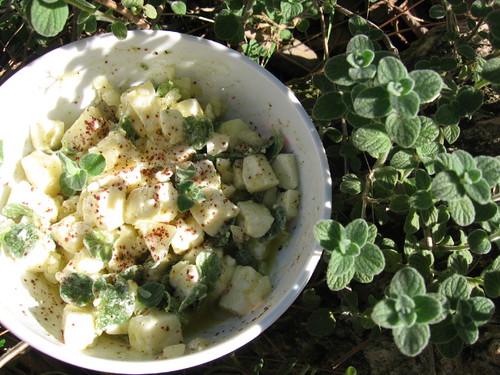
Za'atar and Sahleb


zaatar herb, originally uploaded by afuna.

The parcel that arrived from my mom today delivered more than silk scarves with shimmering coins. It brought with it the mountain air, filled with the mosque-chants of mouazines from nearby villages and the rustic perfume of za'atar. An herb grown wild mostly in Lebanon and the northern parts of Israel, with aroma reminiscent of oregano but milder and sweeter (less pungent and peppery). It can be used fresh, but is more commonly used after it has been dried - it is than kept for seasoning all year around, mixed with sesame seeds and sumac (the latter adding a salty-soud flavour).

This mixture is a staple food in the Middle East, and when mixed with olive oil is used for pita-dipping or spreading on bread, it's as popular as butter, really (only with none of the cholesterol associated with butter). It is also used to top-off Labaneh (a yoghurt cheese, which you can easily make at home yourself, by straining plain and pure yoghurt, preferably of the most sour type you can find, through a cheescloth or a coffee filter; add salt to taste and sprinkle with za'atar and drizzle some olive oil on top before serving). It can also be used to season salads - no salt will be necessary if your mixture includes sumac. The fresh sprigs can be fried lightly in olive oil and than served on fresh bread. They can also be added to salads, pasta sauces and stews.

Half of the small bag of za'atar got spilled on my kitchen floor, unfortunately; the better part was that for several moments, the kitchen smelled like a walk on the mountain behind my house in my home village, in the end of the winter when there are za'atar leaves in abundance and awaiting harvest by shepherds and other passersby.

On another (mental) note, I spent the best part of the morning in the lab replenishing jus for many perfumes that were sold out. The latter being Sahlab, a creamy-starchy orris and musk scent which I decided to wear for the rest of the day. Flavours of my homeland been an important part of my day.

White Peonies


Today I discovered that white peonies not only smell different than the pink or red ones; they are also well worth bending over and perhaps even injuring your back on the way to inhale their delicate perfume.
Trying to describe it, all I can say is that white peonies smell like lily of the valley with a hint of carnation and an even tinier hint of rose. Beautiful is an understatement. The scent was so heavenly I had to keep my nose buried in the cellophane-wrapped bouquet all the way home, ignoring the staring faces of passersby who probably wondered why there's an astronaut walking up Robson Strasse.


Mental Notes: Apple Breeze and More Sweat

I woke up this morning to a surprisingly familiar scent accompanied by the sound of lawn-mowing. It was obviously coming from the grass 4 stories below; but it had the crisp scent of green apples - just like the artificial symbol of green apples, to be precise.

The weather was muggy again, but not so sunny; I was brave enough to go out (even in the evening) with no umbrella and no jacket despite of the clouds though... Aside from a pashimna scurf, the only added accessories to cover my skin were, yet again, Azuree body lotion (ahem, yes, with sprakles), and Film Noir in solid perfume (and inside my pendant). I am again surprised at how dry it comes across on a sweaty day.
Back to the top