
s

SmellyBlog

Pandan Leaves (Pandanus odoratissimus)

You might have tasted Pandan without even knowing it. It's used primarily in Southeast Asian cuisine, in almost all desserts, so much so that it's been coined the "vanilla of the east"*, i.e.: in coconut custard, and mango sticky rice, a very popular Thai dessert, is in fact cooked with pandanus leaves, tied in a knot and removed once its sweet aroma has been infused into the rice and the coconut milk, and of course there are the less traditional but not any less popular pandan flavoured ice cream and gelato, and other simple custard-like European desserts such as Crème brûlée and panna cotta. It can also be wrapped around rice, and steamed, much in the same way as banana leaf, imparting a smooth fragrant aroma that is complementary to the rice.

Pandan leaves behind it a fine, subtle aroma that is so representative of Asian cuisine and aromatics: the aroma is reminiscent of roasted tea leaves, milky oolong, almond cream and basmati rice. And the taste is subtly sweet, like the smooth finish of fine green and oolong teas - sweet at the back of the mouth and the top of the palate.

You can incorporate it rather easily into dishes, savoury or sweet, by tying them into a knot and infusing the liquids with it; or using pandan essence (can be found in some Asian markets and grocery stores), or create your own pandan "juice" by covering cut leaves with water, and blitzing them in a food processor,  followed by straining. You'll get a green juice that can be used just like vanilla extract in baking cakes (and won't turn it green either, just like vanilla extract won't turn your whipped cream black!).
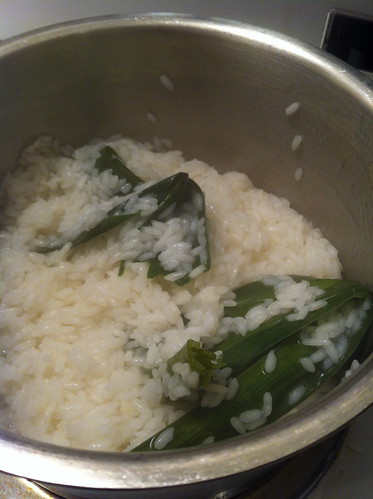

Cooking sticky rice with pandan

Kewda attar, from the pandanus flower oil which is either macerated with sesame seeds or oils, or distilled into sandalwood oil, produces a fine and unique essence. Kewda attar is distinct, exotic, floral, reminiscent of a tropical jungle and flowers all at once. Kewda is extremely heady, and may be perceived as sharp when first smelled. The sharpness being somewhat green, and mostly reminiscent of horseradish. However, the sharpness is underlined by a unique sweetness and warmth. The scent of kewda is unlike any other scent, though some may compare its dry out sweetness to that of hyacinth. The main constituent responsible for its characteristic scent is beta-phenylethyl alcohol(which makes up to 60-80% of the oil). Kewda is mostly used in Indian traditions as a perfume and as a medicine, and hardly made its way to Western perfumery.
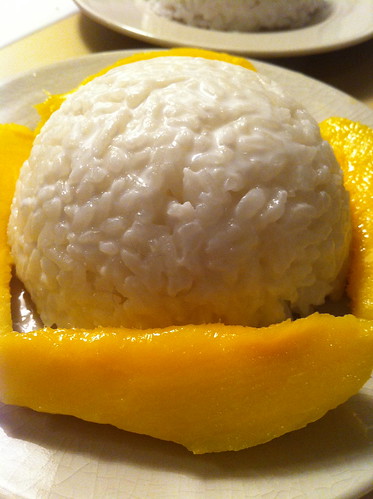
Sticky Rice & Mango Pudding
Although pandanus flowers (aka kewda or kewra) are very popular perfume material in India, I could not find any documentation on using the leaves for perfumery. Out of curiousity, and rather on an impluse, I have began to tincture pandanus leaves in a jar of ethanol and am now crossing my fingers, hoping for the best.
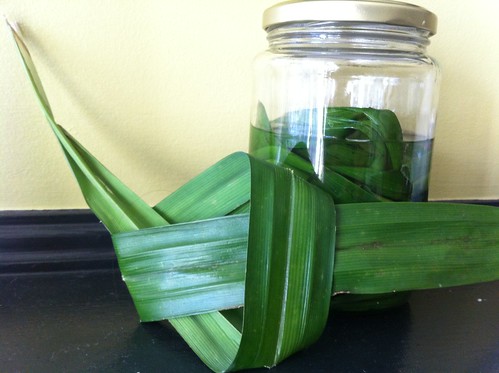


Tincturing Pandan Leaves 

* Interestingly enough, the plants of pandanus have also been used as the foundation to support vanilla orchids in the plantations in Madagascar and the Reunion Islands. 
New Discoveries

New Discoveries by Ayala Moriel
New Discoveries, a photo by Ayala Moriel on Flickr.
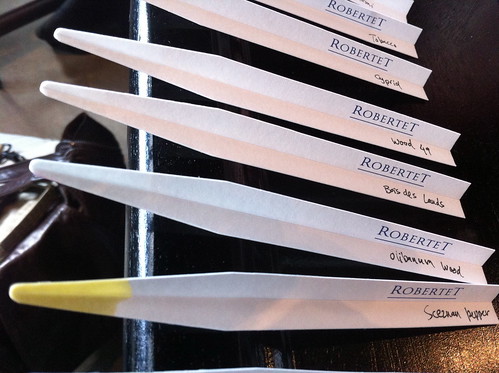
Monday was spent on the road mostly, doing a round trip to Seattle to reconnect with the West Coast indie perfume community, and smell some new raw materials. The fresh Szechuan pepper essence pictured here made the trip worth my while, but there were some other fascinating raw materials worth writing about.

Elemodor: fraction of elemi resin, which possesses no resemblance to its origin, with only the slightest hint of resinous woody. The best way to describe it is as orange zest and juice on speed.

Elemi (Canarium luzonicum): Sharp, crisp, like lemon and black pepper combined, and also with hints of both cilantro leaf and pink peppercorns.

Tobacco absolute: Time and time again, I'm surprised at how muted tobacco is. It can easily disappear in a blend, and it sometimes seems as if the more you add, the less you'd smell of it. A challenging raw material to work with, but powerful and very elegant when used properly. Although it does not have a very strong odour intensity or diffusive power, it is a distinctive note, reminiscent of freshly cured tobacco leaves (read: not stale!), fermented hay in a meadow, and with an undercurrent of animalic energy. A truly good tobacco bring a sense of reverence and reminds me of the original use of this as a sacred, medicinal plant.
Please note that this absolute is nicotine free, unfortunately, so don't try this as a substitute for your nicotine patch!

Cypriol/Cyperus/Nagramotha (Cyperus scariosus): from the vetiver family, this root oil possesses as urpentie, sharp top note, woodsy-dry base, and a very clean, elegant dryout reminiscent of the hint of tart freshness of Haitian vetiver.

Bois des Lands or Pinewood is a co-extraction of French pine resinoid with a Virginian cedarwood oil. Smells of wood, mushroom-y forest floor, moss and a tiny smoky, with a cheese-like fermented undertones. Dries out to a woody-balsamic finish.

Cedarwood fraction: From Texas cedarwood. Sharp cedar note, a little sweaty-herbaceous reminiscent of oregano.

Olibanum Wood: co-distillation of olibanum (frankincense resin) with Virginia cedarwood, which creates an interesting new note that is more stable and woody, more reminiscent of dusty frankincense tears rather than the oil or the smoke.

Vanilla CO2 with 20% vanillin:  This is just about as sweet as one can get, in a very elegant way.

Ambrette Oil (Abelmoschus moschatos): High content of ambrettolide, resulting in a typical "white must" scent without the skin-like, buttery, nutty and wine-like quality of most ambrette seed essences. 

Szechuan Peppercorn, Fresh: Green, floral, surprisingly citrusy (reminiscent of ruby red grapefruit, bergamot  and yuzu), tomato leaf and yerbamate. Very distinct, fresh and tenacious.

Poplar Buds Absolute: Honeyed, boozy, hops-like, hint of cloves, dominant propolis note, hint of nutritional yeast odour.

Mimosa Olessence: Gentler extraction method, resulting in a more true to the flower profile. Reminiscent of almonds, marzipan, hints of fennel, floral, woody and clean.

Elderflower Absolute: That nutritional yeast note again, with only the tiniest hint of what the fresh flowers are all about - cassis-like and floral. More like hay than a flower overall. Similar to linden blossom absolute, which also presents a similar problem.

KF1150: Isolate that smells grassy green and sharp - like a combination of gasoline and freshly cut grass. Your dad is going to love this!

Black Tea Absolute: Smells like a wonderful container full of fresh Assam tea, maybe hints of Darjeeling too.

Eucalyptus Forte: Combination of of solvent extraction and molecular distillation. Green, balsamic, eucalyptus pods, hints of animalic/indolic quality, surprisingly. Very tenacious, resinous-woody-balsamic dryout.

Just a little glimpse into where a perfumer's palette can expand.
And that's all, folks!

Osmanthus Conversations

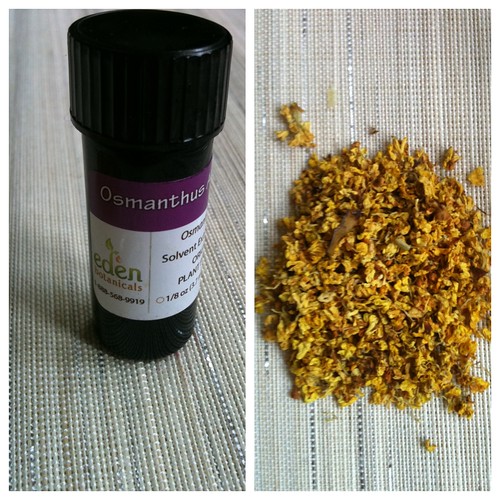
Osmanthus from Eden Botanicals

I'm pleased and excited to begin a new series on SmellyBlog, dedicated to one of my favourite notes: osmanthus. And for the first time - I will be hosting other perfumers who will share their thoughts, impressions and creative process working with this very special raw material.

The idea came to me after visiting Eden Botanicals last summer with my fried perfumer Lisa Fong. We both felt that this osmanthus was so exceptional it called for some special attention. Perhaps a little perfumers conversation on SmellyBlog?

We exchanged some osmanthus goodies - the dry buds, teas mixed with the dry buds, osmanthus oolong and such, and before I  even knew it - September came around, and we met again at the LA Artisan Fragrance Salon and Lisa has already created a new perfume surrounding osmanthus. I was clearly behind on my osmanthus series project - in hindsight perhaps a good thing. Because meanwhile I virtually met another talented and gracious natural perfumer, Charna Ethier, and fell in love with her Osmanthus Oolong. About a month later - Nikki Sherritt launched her Osmanthus Red at her Blackbird event (part of the Northwest Perfumers Circuit). It was clearly time for some action on the osmanthus front!

How can I describe osmanthus to you? 

Osmanthus (Osmanthus fragrans), sweet olive or tea olive (as it is known in the Southern United States) is a flowering evergreen shrub or small tree from the olive and lilac family, native to warm temperate Asia. It is cultivated as a decorative plant in gardens. In China, the dried flowers are used to infuse both green tea and black tea to create a fine tea called guì huāchá. It is also used in Chinese cuisine to flavour other specialty foods such as jam, cakes, dumplings, soups and a specialty liquor.

It is widely cultivated in Japan, where is it called kinmokusei, and where its incredibly humble, tiny clusters of golden-orange flowers permeate the air at the end of October, releasing a scent in the air that truly cannot be replicated. Marlen Harrison, who lived in Japan for a while, was the first to tell me of this elusive scent in real life, and how he spent hours searching for its source - so perfumey that at first he thought it was a laundry dryer sheet scent until he looked up and saw the osmanthus trees and their tiny, inconspicuous flowers.

And indeed, fresh osmanthus has been largely imitated by popular shampoo brand Herbal Essence and its smell-alikes; and even some laundry detergents and dryer sheets; and only later on in Serge Lutens' Nuit de Cellophane (by which point the scent sadly lost some of its prestige). Somehow, the ethreal quality of fresh osmanthus flowers got poorly interpreted and its lush, rich beauty watered-down in the many inspid aquatic florals that took over the 90's, alongside other "Asian" themes such as water lily and bamboo.

The flowers are solvent-extracted to produce a green, viscous liquid with an unusual floral note with a rich and dense aroma: fruity, leathery and green all at once and  reminiscent of leather, apricots, green tea and coumarin. It is sweet, mysterious and exotic. It's fruity intensity is more pronounced in higher quality grades, while poorer quality might present a hint of rancid-oil facet.

Osmanthus is a heart note that is used as the main theme or as an accessory note to add an exotic and unusual dimension to a perfume. It works very well in both rich florals and green florals, orientals, fresh fruity florals, leather and chypre compositions and can make a great floral note in a masculine scent, although it is sadly underused in this regard.

Its beauty is particularly revealed when accompanied with ionone-dominated and tea-like notes (i.e.: green tea, violet leaf, linden blossom, cassie) and fruity floral notes such as jasmine, magnolia, rose and orange blossom.  It's main challenge, however, is that this delicate and complex note is often cluttered with too many other dominant notes that tend to conceal it; and the other big technical challenge is that it is a little shy and tends to disappear the more you add of it. This could be in part due to the fickle character of the ionones in it.

Osmanthus flowers are minuscule, and the yield is low - a classic recipe for prohibitive costs. Therefore it is not surprising that it is not a common note to find - especially not in its natural form. You'll find very few perfumes that are a true ode to osmanthus, and even they are often watered down versions of the glorious original. More often, osmanthus will come up in perfumes that are minimalist, as if to attract the potential markets in Asia (Osmanthe Yunnan and Ormonde Jayne's Osmanthus for example, where it is light, ethereal and evoking green tea and cologne); while in others it is incredibly powdery, fruity-sweet and girly (Keiko Mecheri's and The Different Company's rendition). Only rarely will a perfumer explore its darker, leathery sides, as Ineke did in Evenings Edged in Gold, where the ionone and apricot of osmanthus is paired with leathery saffron. And in even rarer cases there is an original take on osmanthus: the bitter, herbaceous rose of 1000 de Patou; and the insanely too-good-to-be-true dessert of Un Crime Exotique. And then, of course, there are the creations of the perfumers that will be part of this little osmanthus series. It will be really interesting to read their own descriptions and insights into this less-known perfume note.

Hiding from the Muse

Catching Fire by AmyJanelle
Catching Fire, a photo by AmyJanelle on Flickr.
יום אחד זה יקרה"
בלי שנרגיש, משהו ישתנה
משהו יגע בנו, משהו ירגע בנו
ולא יהיה ממה לחשוש.
(...)
וזה יבוא, אתה תראה
הידיים הקפוצות יתארכו
והלב השומר לא להיפגע יפעם בקצב רגיל
זה יבוא, כמו שהטבע רגיל
 ."להיות שלם עם עצמו
(Rita)
 
When does self-expression cross the lines and becomes kitsch? When does pathos stops moving us and becomes overbearing?

An artist is always on the tightrope, finding that balance between the too-much and the too-little. A hint, a glimpse, a beginning of a smile and the words that weren't said are often more important than what shows on the screen.

And sometimes a few minutes of genuine performance, truthful art can inspire you for weeks and give that "natural high"; a strong feeling of inspiration, leading to motivation, leading to the urge to express - create - do.

The relationship between an artist and his "muse" is complicated only if he is too caught up in a narcissistic chase for his own reflection in the lake. True inspiration comes from life, not from being chased (sorry, Jack London, I don't agree with you!).

The muse - or inspiration - is not a lover that needs to be chased or courted. It is the holy spirit that is always there, if we only let it come to us. It's not the muse who is avoiding contact - but the opposite: we are hiding from it; or worse - escaping it.


But that requires patience. Not waiting for the muse; but waiting for oneself to complete the cycle. Wait for the "dry spell" to pass. Because, in truth, there was never a dry season. There was only the time for the rain to collect and condense in the clouds. And when the clouds are filled to the brim, they will pour.

Just like Jonah hiding in the whale's belly, an artist might just need to hide for a while in the mundane, often times plagued by fears of impotence. Rather than fighting it, doing the hard work and fulfilling life's demands in the only cure for losing inspiration. In fact, it is the inspiration.

Nature, Resources & Rights

And some more food for thought about putting our priorities in order when it comes to taking care of Mother Nature's rights. Ecuador was the first country where humans (also happen to be of American citizenship) were sued for crimes against nature.

Beauty, abandon and abundance - an inspiring and thought provoking photo essay that makes us wonder if really the planet won't be much better off without us. It seems like humanity's extreme need for order actually achieves the opposite.
Back to the top